A Home Gym With Nowhere to Plug Anything In
Six of the eight things in this catalogue train you with no electricity in the room at all — and the one machine everybody assumes needs a socket does not either. Its batteries are in the screen, not in the resistance.
This guide contains affiliate links. Buying through one costs you nothing extra and pays for the research. As an Amazon Associate I earn from qualifying purchases. How this site is funded →
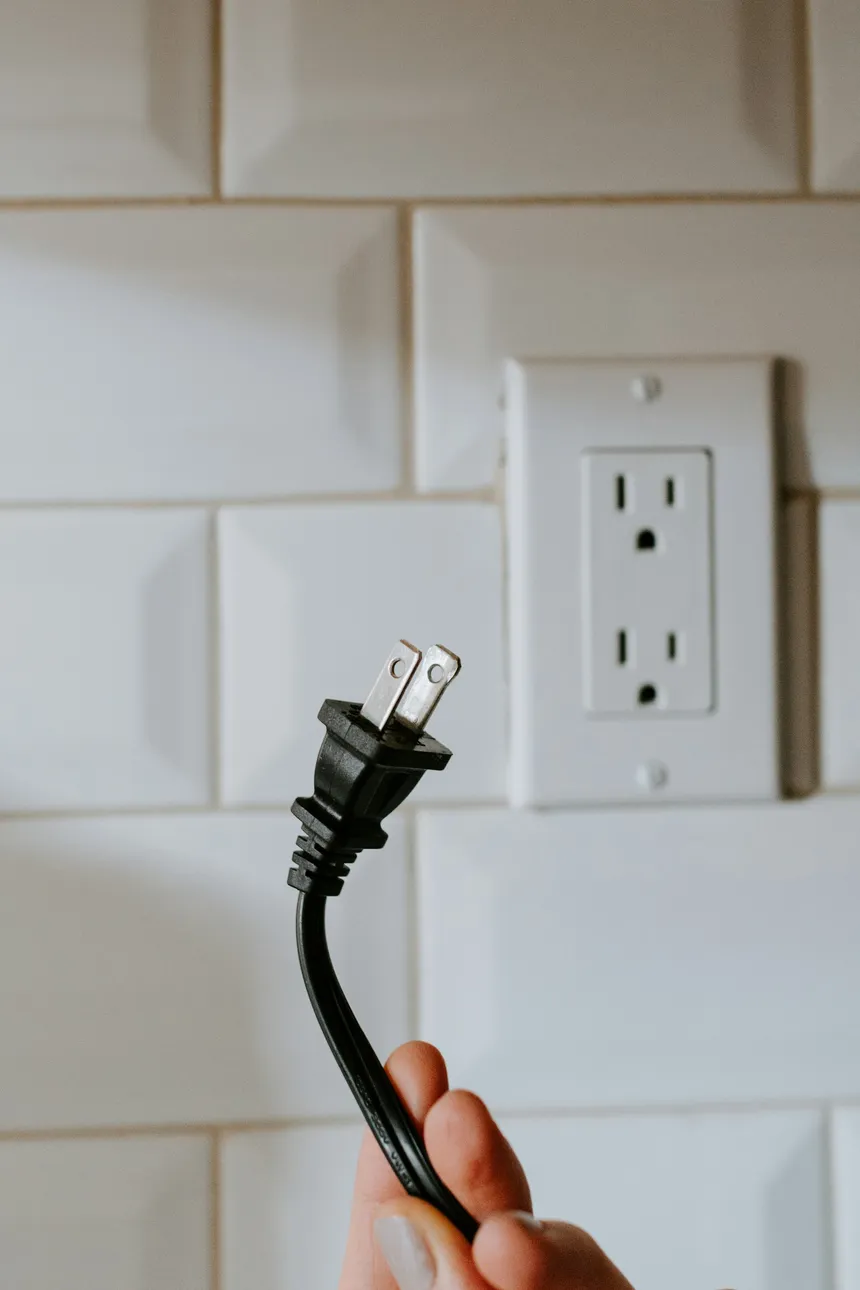
There is one socket in that room. The lamp is in it, or the router, or a fridge you are not allowed to unplug. The nearest free one is across a doorway and you are not running a cable across a doorway.
So you have quietly written off half the catalogue. Cardio especially — a bike is a machine, a machine has a screen, a screen needs a plug, and that is the end of it.
That chain of reasoning has exactly one weak link, and it is the last one. It is worth pulling on, because the thing you crossed off does not need your socket.
What this covers
A room with no free mains outlet: a spare room with one socket behind the bed, a garage with a single strip already carrying a freezer, a flat where the only free plug is nowhere near the space you would train in.
The classifications below come from what each mechanism physically is, plus the power fields read off the live listings on 1 September 2026. Where a figure came off a listing rather than out of the physics, it says so.
Almost nothing in a home gym needs power
Start with what is true and boring: a dumbbell has never needed electricity. Neither has a plate, a band, or a strap over a door.

Six of the eight rows above train you with nothing plugged in anywhere. That covers every resistance movement a home gym is built around: pressing, rowing, squatting, hinging, carrying.
If your constraint is a socket and your goal is to get stronger, you can stop reading here and buy almost anything on this site. The problem was never strength. It is always cardio that people give up on.
The bike is where the assumption breaks
Here is the part that gets crossed off a list it does not belong on.
On a belt-drive magnetic bike, the resistance is a magnet held near a steel flywheel. Turn the knob, the magnet moves closer, pedalling gets harder. That is the entire mechanism, and there is no point along it where current does anything.
What draws power is the console — the display, and the Bluetooth radio that talks to a phone. On the bike below, the technical detail field on the listing reads Power Source: Battery Powered, and owner reporting on the same listing describes adjusting resistance with a single knob, with one owner asking for a backlight so that battery use is reduced. Both halves point the same way: the batteries live in the screen.
Take the batteries out entirely and you lose your numbers. You do not lose the workout.

That is worth knowing before you buy, because “app-connected”, “100 resistance levels” and “LCD monitor” all read like a product that wants a wall socket, and none of those three phrases tells you how the resistance is produced.
What genuinely does need mains
Two categories, and they are the ones to avoid if a socket is your constraint.
A motorised treadmill. The belt is driven by a motor. There is no version of it that runs on batteries, and there is no meaningful workout when it is unplugged. If you want to run indoors without power, you want an approach that is not a treadmill — which is also the better answer in a flat for entirely separate reasons.
A digitally loaded cable trainer. The all-in-one machines that generate resistance electronically produce exactly zero pounds of load with the plug out. That is the trade you make for one-pound increments and a screen, and it is covered in full here.
Everything else on this page is indifferent to your wiring.
Two things people get caught by
A battery-powered console still needs batteries. Buy them with the machine. A bike that arrives on a Saturday with a dead display is a bike nobody rides on Sunday, and the first ninety days are when that matters most.
“Rechargeable” is not the same as “needs no mains”. A console you have to recharge every few weeks needs a socket eventually, just not permanently. That is usually fine — you carry the console to a plug, not the machine — but check which one you are buying.
The verdict
Cardio for a room with no free socket
pooboo Magnetic Belt-Drive Bike
- Drive
- Belt
- Resistance
- Magnetic, 100 levels
- Capacity
- 350 lb
- Sold by
- benrun
- Power source
- Battery powered
What we like
- The listing's Power Source field reads "Battery Powered" — no mains requirement
- Resistance is a magnet moved by a mechanical knob, so it works with a flat battery
- Belt drive, which is the quiet choice in a flat as well as the low-maintenance one
- Rated to 350 lb
What we don't
- Sold and shipped by benrun, a third party — returns run through them, not Amazon
- The display is the part that fails you, and it fails silently when batteries die
- Owner reports note the display is not backlit, which matters in a dim garage
The pooboo magnetic belt-drive bike is here because it removes the one category people wrongly believe a socket blocks. It is not the quietest possible cardio and it is not the cheapest — it is the one that turns “no outlet” from a dealbreaker into a shopping note about batteries.
The field
| Product | What it needs plugged in | Best for | Buy |
|---|---|---|---|
| pooboo Magnetic Belt-Drive BikeOur top pick | Battery powered | Cardio with no socket in the room | Check price → |
| WHATAFIT Resistance Bands Set | Nothing | A whole gym in a drawer, no power | Check price → |
| TRX GO Suspension Trainer | Nothing | Pulling movements off a door frame | Check price → |
| BowFlex Results Series SelectTech Dumbbells | Nothing | The widest load range, no power | Check price → |
| PowerBlock Sport 24 | Nothing | A lighter pair, no power | Check price → |
| Yes4All Spinlock Set | Nothing | The cheapest load, no power | Check price → |
| BowFlex SelectTech 840 Kettlebell | Nothing | Conditioning without a machine | Check price → |
The socket is taken and you want conditioning, not just strength
A bike whose resistance is mechanical is the direct answer. An adjustable kettlebell is the answer that needs no batteries either — swings and carries raise a heart rate as effectively as pedalling, and the trade is impact and noise rather than watts.
Check the bike on Amazon Check the adjustable kettlebellIt is a garage with one strip already carrying a freezer
Then keep the strip free and buy nothing that competes for it. Bands and a suspension trainer put the whole gym in a drawer and load a door frame or a beam, and the cold-storage question that a garage raises is a separate one.
Check the band set on Amazon Check the suspension trainerYou want real load and never want to think about power again
Then the whole question disappears. A selectorised pair has no console, no battery and no failure mode that involves electricity — the things that break on it are all mechanical.
Check the pair on Amazon Check the plate set insteadWhat breaks, and who fixes it
On the powered half of a home gym, the console fails long before the mechanism does — and on a battery console the failure is not dramatic, it is just a blank screen one morning. The bike still works. Whether you still ride it is a different question, which is the real reason to keep spare batteries in the room.
On everything else here, there is no electrical failure mode at all, because there is no electricity.
Returns: the bike is sold and shipped by benrun, the band set by WHATAFIT LLC and the suspension trainer by TRX Training — all third parties, so returns run through the seller rather than Amazon. The selector pair, the plate set and the kettlebell are sold and shipped by Amazon.
Before you buy: four checks, thirty seconds each
- Find the Power Source line in the technical details on the listing, not in the marketing copy. “Battery Powered” and “Corded Electric” are different products.
- Ask what moves the resistance — a knob, or a button. A knob is mechanical. A button on the console usually is not.
- Check whether the console is required to start, or only to display. On a mechanical bike it only displays.
- Buy the batteries at the same time, and put a spare set in the room.
Questions people ask
Do exercise bikes need to be plugged in? Some do and some do not, and the listing tells you which. A bike whose resistance is a magnet moved by a mechanical knob needs no mains at all; its console runs on batteries. A bike that sets resistance electronically does need power.
Does a magnetic bike work without batteries? The pedalling does. You lose the display — time, distance, calories — and on an app-connected model you lose the pairing. The resistance knob is unaffected.
What home gym equipment needs no electricity at all? Free weights of every kind, resistance bands, and a suspension trainer. That covers essentially all resistance training.
Is there such a thing as a non-motorised treadmill? Yes — curved manual treadmills exist and need no power, but they sit far above the price bracket this site covers and are heavy enough to raise a floor question of their own.
Sources and method. Power classifications come from the technical detail fields on each live listing, read on 1 September 2026, and from what the mechanism physically is. The bike’s Power Source field reads “Battery Powered”; the description of a single resistance knob and the request for a backlight to reduce battery use are owner reports on that same listing, not our own testing — this site does not buy or use the equipment it ranks. Product specs were read from the live listings between 28 August and 1 September 2026.
Bought something whose listing said one thing and did another? Tell us.
More on how these are put together in how we research, and the rest of the cluster in Apartment Gyms.
Specifications here are checked against the live listing on the date shown, and figures we derive ourselves are labelled where they appear.
How we research →