Home Gym Equipment Maintenance: Three Clocks, Not One
Almost nothing in a home gym wears out from being trained with. One clock advances every time you operate a mechanism, one advances every year whether you touch it or not, and one advances every hour the room sits above 60% humidity — and that last one is the only maintenance most people actually need to do.
This guide contains affiliate links. Buying through one costs you nothing extra and pays for the research. As an Amazon Associate I earn from qualifying purchases. How this site is funded →
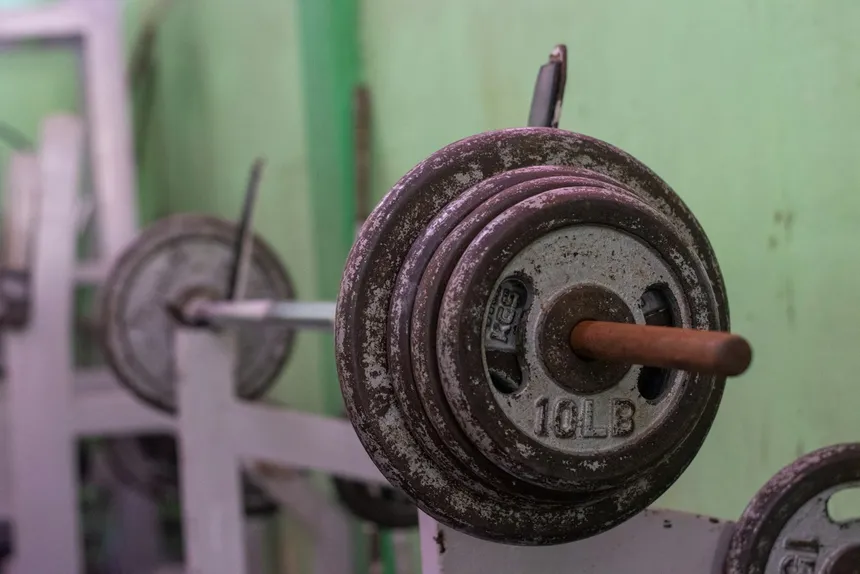
The handle left something on your palm this morning. Not chalk. A faint orange smear that wipes off on a cloth and is back the following week.
Nothing has broken. Everything still lifts. And you are now doing what everyone does at this point, which is looking for how often you are supposed to service a dumbbell, and finding nothing, because the manual said wipe after use and then stopped.
Here is the part nobody puts in the manual. Most home gym equipment needs almost no maintenance at all, and the small amount that does need it is not spread evenly across your room. One or two things are quietly on a schedule. The rest genuinely are not.
And the things on a schedule are usually the cheapest objects you own — held to a schedule that has nothing to do with how much you train.
What this covers
Free weights, adjustable sets, bands, straps and a stationary bike: the kit that fits in a spare room and gets bought one piece at a time. Above it sit commercial machines and treadmills, which have belts, decks and motors and a genuine service manual. Below it there is nothing to maintain.
Two of the numbers on this page are published standards rather than anyone’s opinion, and one comes from the materials field of a listing that states what its product is actually made of. Where a figure is ours, it says so.
There are three clocks, and only one of them is training
The mistake is thinking of wear as a single thing that gets used up. It is at least three different processes with three different triggers, and they do not run at the same speed on the same objects.
The use clock advances when you operate a mechanism. Selector pins, dial cams, screw threads, belts and bearings all sit here, and nothing on this clock cares how long you own the thing — only how many times it has been worked. That is the clock the durability question is usually about, and we took it apart in what breaks on adjustable dumbbells.
The calendar clock advances whether or not anyone touches the object. Natural rubber oxidises in a drawer. Webbing and stitching age on a hook. This one is genuinely counter-intuitive: the band you have never used is not in better condition than the one you have, it is just less stretched.
The room clock advances for every hour your kit spends in damp air. It is the only clock of the three that you can stop, it is the one nobody measures, and it is where almost all real maintenance turns out to live.
The clock nobody watches is the room
Steel does not rust as a function of use. It rusts as a function of the water film sitting on it, and that film appears at a threshold that has been in the corrosion literature for decades.
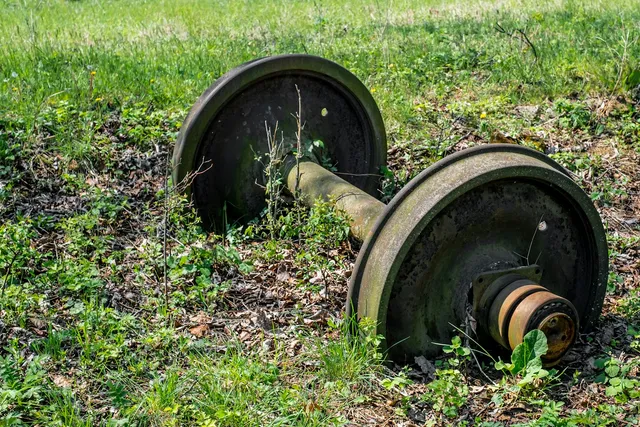
Below roughly 60% relative humidity, bare iron and steel do not meaningfully corrode. At about 60% — the primary critical humidity — enough water accumulates on the surface for rusting to begin, very slowly. Somewhere between 75 and 80% the rate climbs sharply, generally attributed to capillary condensation of moisture inside the rust layer itself, which then holds water against the metal.
That upper threshold is not folklore. ISO 9223, the standard that classifies how corrosive an atmosphere is, defines time of wetness as the time relative humidity is above 80% while the temperature is above 0 °C — and time of wetness is the quantity the whole model is built on.
Now put a number next to it that you have probably already met. The EPA’s own guidance for indoor air is that relative humidity should be kept below 60%, ideally between 30 and 50%.
It is the same number. The humidity ceiling that keeps mould out of a room is the humidity ceiling that keeps rust off bare steel, and if you have already fixed one you have fixed the other without knowing it.
This is the whole finding of this page, and it inverts the question people arrive with. A set that has sat untouched for a year in an unheated garage is in worse condition than an identical set used four times a week in a heated flat. Training is not what damaged it. The room did that, on its own schedule, while nobody was in there.
Which means the single most useful piece of maintenance equipment is not oil or a cover. It is a hygrometer, left where the kit lives for a week.
The coating is the maintenance item, not the steel
Cast iron does not resist corrosion. The finish on it does, and the cheapest plate sets say so plainly in their own product copy: cast iron plates with a powder-coated finish that resists rust and corrosion. The protection is a layer, not a property of the metal.
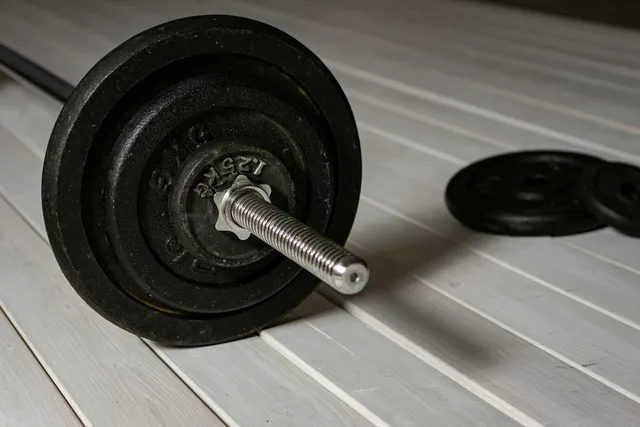
So the maintenance job is not oiling iron on a schedule. It is watching the places where that layer has gone. Every chipped edge is a spot where the room clock starts running locally, on bare substrate, at whatever humidity that room happens to sit at.
And chips are not rare. Owner reports on the plate set recommended below include chipped plate edges out of the box and collars arriving with rust already on the threads — while another owner, four years in and indoors, reports an older rubber-handled set that rusted and this one that has not. Both of those are consistent with the same mechanism: coating plus dry room equals nothing to do, and broken coating plus damp room equals a schedule.
The threads themselves are a wear part, but a slow and forgiving one. What kills a screw thread is grit ground into it under load, not the number of times it has been turned — which is why the useful habit is running a cloth down the thread, not counting operations.
Elastic does not wait for you
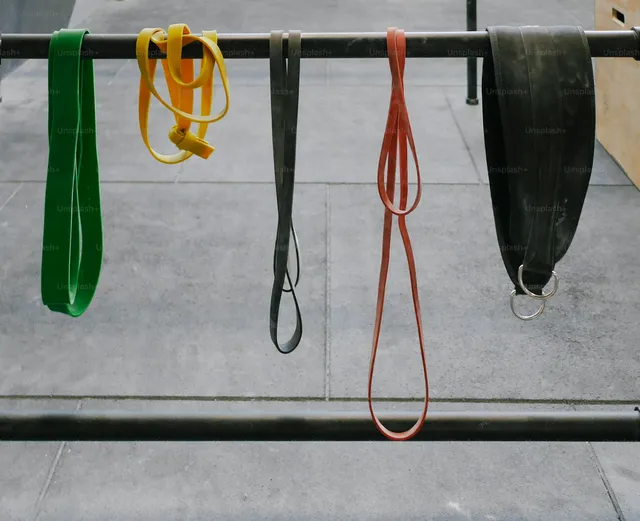
The material field on the resistance band set in this guide reads natural rubber. That single word moves the whole product onto the calendar clock, because natural rubber oxidises and ozone-cracks in storage regardless of whether anyone pulls on it.
There is no maintenance that fixes this. There is only inspection, and then replacement. Anyone selling you a conditioner for it is selling you something the material does not care about.
What inspection means in practice is looking at the ends. Stress concentrates where the tube enters the handle and where it meets the anchor clip, so that is where a failure starts — and a band failing under tension travels back towards the person holding it. That is the reason to inspect on a habit rather than a date: nobody publishes a service life for these, ourselves included, and we are not going to invent one.
If bands are carrying most of your training, the honest limits of that are in are resistance bands enough.
You cannot maintain what you cannot see
This is the limit on the whole exercise. A selector has to be enclosed in order to work, and enclosing it removes it from your inspection routine permanently. You can keep the outside clean. You cannot see the part that fails, and no schedule you follow will change its condition.
It cuts the catalogue in two. Kit whose wearing parts are exposed can be maintained, and the reward for maintaining it is real. Kit whose wearing parts are sealed cannot be maintained, which is not a criticism — it is simply the trade you made, and it means the money and the warranty do the job your cloth would otherwise do.
The same split is why we tell people to buy iron used and buy mechanisms new.
The verdict
If the question is what stands up best to being owned for years, the answer is the thing with nothing hidden in it and no proprietary part in the load path.
The one you can actually service
Yes4All Spinlock Set
- Type
- Screw collar
- Adjustment
- Manual, ~40 sec
- Sizes
- 40–200 lb total
What we like
- Every part that wears is separate, visible and replaceable — a seized collar is a part, not a dead set
- Cast iron under a powder coat: the failure mode is slow, local and visible rather than sudden
- Nothing on it is on the calendar clock — leave it a year in a dry room and it is unchanged
- Shipper and seller are both Amazon, so returns and any claim run through one party
What we don't
- The only thing here the room can damage while you are not using it
- Owner reports on the live listing include chipped plate edges and collars arriving with rust on the threads
- The rubber washers between plate and collar are a consumable you are expected to source yourself
- About forty seconds per load change, which no amount of maintenance improves
Read the variant wording before you pay: the sizes are stated as a total across both handles, not per hand, and it is the most expensive misreading in the category. We took the listings apart in are adjustable dumbbells sold in pairs.
The field
| Product | Governing clock | Best for | Buy |
|---|---|---|---|
| Yes4All Spinlock SetOur top pick | The room | The only set here you can strip, inspect and replace one part of | Check price → |
| PowerBlock Sport 24 | Use | A pin selector with little to keep clean and a known weak part | Check price → |
| BowFlex Results Series SelectTech Dumbbells | Use | A sealed dial that asks nothing of you and gives nothing back | Check price → |
| Core Fitness Adjustable Set | Use | A dial pair whose returns and parts run through its own brand | Check price → |
| BowFlex SelectTech 840 Kettlebell | Use | One mechanism that also gets dropped, which is the hardest combination to inspect | Check price → |
| WHATAFIT Resistance Bands Set | Time | A consumable to replace on inspection, not a thing to maintain | Check price → |
| TRX GO Suspension Trainer | Time | Webbing and stitching, checked by eye in ten seconds | Check price → |
| pooboo Magnetic Belt-Drive Bike | Use | The only drivetrain here — a belt and bearings on a duty cycle nobody publishes | Check price → |
Your kit lives in a heated flat
Then the room column is blank for everything you own, and rust is not your problem — the hygrometer will tell you that in a week. Buy for how you train, because the only clock still running is the use clock, and pick the mechanism you will operate most happily.
See the dial pair See the pin-selector pairYour kit lives in a garage, a shed or a basement
The room clock is running, and it does not stop when you skip a week. Get the space under 60% first — heating and ventilation, or a dehumidifier — and then buy the thing whose corroding parts are cheap, visible and individually replaceable, rather than sealed inside a housing you cannot open or inspect.
See the plate set See the pin-selector pairYou want equipment that never asks you for anything
Then buy from the calendar clock and accept what that means: nothing to service, nothing to oil, nothing to rust, and a replacement every few years because the material ages on its own. Straps are the more durable half of that pair — webbing and stitching outlast latex — and they store in a drawer, which is its own kind of maintenance.
See the TRX listing See the band setYou want a machine, and you want it to still work in five years
A bike is the only thing here with a drivetrain, and a belt and bearing set is the only genuine consumable in this guide. Nobody publishes a duty cycle for either. Keep it out of the damp, keep the flywheel area clean, and know before you buy that this one ships from a third-party seller, so parts and returns run through them rather than through Amazon.
See the bike listing See the adjustable kettlebellIf the room itself is the constraint rather than the kit, the noise and neighbour version of that problem is in quiet home gym equipment for apartments, and the rest of the category is in Strength Equipment.
The whole routine, and it is shorter than you think
Not a schedule. A set of habits, none of which takes more than a minute.
- Wipe sweat off bare metal the same session. Sweat is salted water, and salt on steel drops the humidity at which corrosion starts. This is the one job that is genuinely urgent.
- Run a cloth down any exposed thread before you load it. Grit under a collar is what wears a thread; turning it is not.
- Look at the chips once a month. Every place the coating has gone is where rust will start first. A dab of any paint is enough — the point is to close the gap, not to match the colour.
- Hold the bands up to a light before a session, at the handle and the anchor clip. You are looking for surface cracking and thinning, not for a date.
- Feel the strap stitching where it takes the load. Fuzzing at the edge of a stitch line is the early signal on webbing.
- Do not seal cold metal under a plastic cover. It traps condensation against the surface and creates exactly the film the corrosion threshold is about.
- Read the hygrometer once a season. It is the only measurement here, and it is the one that decides how much of the rest matters.
Before you buy anything else
- Put a hygrometer where the kit will live and leave it a week. Anything above 60% makes the room part of your buying decision, not an afterthought.
- Read the Material field on the listing, not the marketing copy. “Cast iron” and “natural rubber” each tell you which clock you are signing up for.
- Ask what the smallest replaceable part is. If the answer is the whole unit, you are buying a warranty rather than a serviceable object.
- Check who the seller is, not just who ships it. Returns and spare parts run through the seller, and on several products in this guide that is not Amazon.
- For anything elastic, buy assuming you will replace it. Budget the second set at the same time as the first, or you will train on a cracked one.
- Check any second-hand mechanism against the recall list before money changes hands — we keep the running record on our recalls page.
Questions people ask
How often should I oil my weights? In a room below 60% relative humidity, effectively never. Above it, the answer is to fix the room rather than to buy oil.
Do adjustable dumbbells need servicing? No manufacturer here publishes a service interval, because there is no user-serviceable part inside a selector. Keep the outside clean and the dust out; there is nothing else you can reach.
Will my weights rust in the garage? Above roughly 60% humidity, yes, slowly. Above 80% — ISO 9223’s time-of-wetness threshold — considerably faster. An unheated garage in most climates sits in that range for months at a time.
Do resistance bands expire? Natural rubber degrades in storage, so functionally yes, though nobody publishes a shelf life. Inspect at the handle and anchor rather than working to a date.
Is a water-displacing spray the right thing for rust? It displaces water, which is useful after the fact; it is not a long-term protective film. For a knurled handle, a light machine oil wiped almost dry is the general practice, and dry is the operative word — an oily handle is a dropped dumbbell.
Should I cover my equipment? Only if the cover breathes. Sealing cold steel under plastic holds condensation against it, which is the one thing the whole corrosion threshold is describing.
Is rust on a plate a safety problem? Surface rust on cast iron is cosmetic. Rust on a thread, a collar or anything in the load path is not, because that is where the plate is held on.
The 60% figure for the onset of rusting on iron and steel, and the sharper rise between 75 and 80%, are the published critical-humidity values from atmospheric-corrosion work; the time-of-wetness threshold — relative humidity above 80% with temperature above 0 °C — is the definition in ISO 9223. The indoor humidity guidance is the EPA’s own: keep it below 60%, ideally 30 to 50%. The shape of the curve in our chart is indicative and the y axis carries no units by design — we are claiming a threshold, not a rate. The three-clock classification, the room ranges and the count of parts that fail invisibly are our own editorial judgement rather than anyone’s specification. Product materials, sellers and availability are the live listing fields, read on 28 and 29 August 2026, including the powder-coat wording and the owner reports quoted above. We do not buy or use this equipment and we have not run any of it to failure; everything here is drawn from published standards and aggregated owner reporting, which is the standard we hold ourselves to. If something here stops matching what you can see, tell us and we will correct it. More on the method in how we research, and more of the same in Strength Equipment.
Specifications here are checked against the live listing on the date shown, and figures we derive ourselves are labelled where they appear.
How we research →