Is a Home Gym Cheaper Than a Gym Membership?
The industry's own retention figures answer this better than any price comparison: the most common reason people cancel a membership is not visiting enough to justify it. That is a cost-per-session problem, and it is the one thing equipment cannot fix and cannot make worse.
This guide contains affiliate links. Buying through one costs you nothing extra and pays for the research. As an Amazon Associate I earn from qualifying purchases. How this site is funded →
The direct debit went out again this morning. You know roughly when you last used it, and you know that “roughly” is the answer of somebody who has not been in a while.
So you start doing the sum. Equipment against membership, months against dollars, and every version of it you attempt comes out ambiguous, because you cannot honestly fill in the one variable the whole calculation depends on: how often you are going to train.
That variable is not a detail you can round off. It is the entire answer.
And there is a published number that settles most of this before you buy anything, which almost no comparison of the two mentions.
What this covers
Free weights, bands, a suspension trainer and one cardio machine bought once, against a general health-club membership paid monthly. Not a personal trainer, not a boutique studio, not a commercial rack you would need a garage for.
No figure on this page is a price. The site never prints one, and here that restriction turns out to be an advantage rather than a nuisance: the honest way to compare a single outlay with a recurring charge is to express one in terms of the other. So the unit throughout is months of an average membership, and then sessions, and the arithmetic behind both is stated where it is used.
The number that decides it
When members are asked why they cancelled, the answer that comes back first is not price. It is that they were not visiting enough to justify the cost — 46% of cancellations, ahead of financial pressure at 22% and relocation at 15%, in the reason breakdown attributed to IHRSA research. Around half of new members are gone inside six months.
Read that again with a buyer’s eye, because it is not a motivational statistic. It is a cost per session complaint, filed by people paying the lowest per-session rate available to them, in a building full of equipment they will never have to store, maintain or resell.
Alongside it sits the attendance figure that explains it: average member attendance is reported at about 1.5 visits a week in 2024, down from 2.1 in 2019.
So the average membership is bought at a rate of roughly six and a half sessions a month, and the most common reason it gets cancelled is that six and a half was not enough to feel like value.
That is the real comparison. Not equipment against membership — a fixed charge against a variable you have already been told, by a large industry’s own retention data, that most people overestimate about themselves.
The same kit, priced in memberships
Once the unit is months rather than currency, the catalogue stops looking like a purchase and starts looking like a subscription paid up front.
A band set is half a month. A screw-collar plate set is about one. The suspension trainer and the adjustable kettlebell are two and a half each, an exercise bike or a pin-selector pair about three and a half, and the dial-selector pairs — the expensive end of everything this site covers — are about six and a half.
Six and a half months. That is the most expensive single item here, expressed against the charge it replaces, and it is still shorter than the period in which half of new members quit.
The cheap end is more striking. At the average attendance rate, a plate set has been paid for in seven sessions. Not seven months. Seven sessions — under two months of turning up at a rate that, by the industry’s own account, most people do not sustain anyway.
Why all the risk sits in the first month
The two things being compared do not have the same shape, and the shape is what matters.

Equipment is a hyperbola. Your first home session costs you the whole purchase. Your fifth costs a fifth of it. By session twenty-three the pair has cost less per use than a gym visit, and after that the curve flattens into irrelevance — at a hundred sessions the difference between the cheapest and the most expensive kit on this site is smaller than the difference between using it and not.
A membership is a horizontal line, and the direction it can move is the wrong one. Skip a fortnight and your cost per visit rises. Skip a month and it doubles. The dashed line on that chart is the same membership at two visits a month instead of six and a half, and it sits more than three times higher.
That is the asymmetry the price comparison misses. One of the two can only ever get cheaper. The other gets more expensive precisely when you are least in the mood to notice.
What the sum does not capture
Three things sit outside the arithmetic, and two of them go against the equipment.
A membership includes range you cannot buy. A rack, a full dumbbell wall, cable machines, a platform. Everything in this catalogue tops out well short of that, and how much weight you actually need is the question to settle before assuming that matters to you.
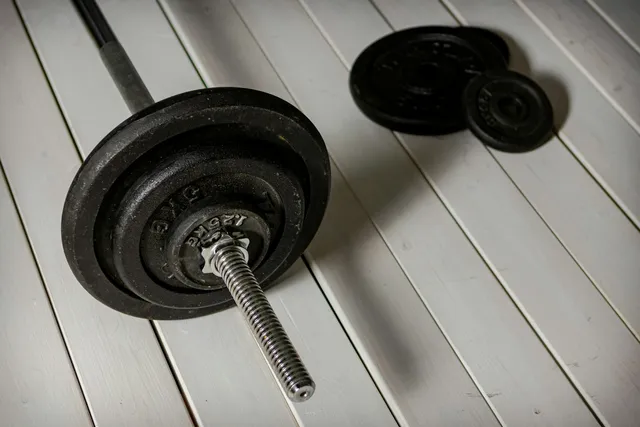
Equipment can go unused too, and it does. The failure mode is different but the outcome is identical, and it has its own guide here, because a purchase that stalls at session four has the worst cost per session on this page by a wide margin.
Equipment has a resale value and a membership has none. Cast iron in particular barely depreciates, which is the whole basis of buying second-hand — and it works in both directions when you come to sell.
The verdict
Break-even in about seven sessions
Yes4All Spinlock Set
- Type
- Screw collar
- Adjustment
- Manual, ~40 sec
- Sizes
- 40–200 lb total
What we like
- The shortest break-even of anything on this site — roughly one month of an average membership
- Cast iron and steel: almost nothing to fail, and it holds resale value
- Sold and shipped by Amazon, so returns run through Amazon
- Expandable in plate increments rather than replaced when it gets light
What we don't
- Around 40 seconds per change against about 3 on a dial, and it is the thing that gets skipped
- Loose plates and collars: the worst item here to tidy, and the one the room can rust
- The entry variant is 20 lb a hand, not 40 — read the variant before you pay
The Yes4All spinlock set wins this particular page on the argument the page is about, and on nothing else. If the honest answer to “how often will I train” is I do not know yet, then the correct purchase is the one whose break-even lands before you find out — and seven sessions lands before almost anybody’s motivation does.
It is not the best equipment here. It is the cheapest test of the assumption everything else depends on.
The field
| Product | Break-even at the average rate | Best for | Buy |
|---|---|---|---|
| Yes4All Spinlock SetOur top pick | About 7 sessions | Testing the habit before spending on it | Check price → |
| WHATAFIT Resistance Bands Set | About 3 sessions | The lowest possible entry cost | Check price → |
| BowFlex SelectTech 840 Kettlebell | About 16 sessions | One object, quickest to actually use | Check price → |
| TRX GO Suspension Trainer | About 16 sessions | Pulling, with nothing to store | Check price → |
| PowerBlock Sport 24 | About 23 sessions | The changeover time a membership never charges you | Check price → |
| pooboo Magnetic Belt-Drive Bike | About 23 sessions | Replacing the cardio floor specifically | Check price → |
| BowFlex Results Series SelectTech Dumbbells | About 42 sessions | The widest range, if the habit is already proven | Check price → |
You have never trained consistently and you know it
Buy the shortest break-even you can and treat the outlay as the price of finding out. Both of these are paid off inside the first month of an ordinary attendance rate, and neither is a purchase you will resent if it goes wrong.
Check the plate set Check the band setYou already train two or three times a week and the commute is the problem
Then the arithmetic is settled before you start and the constraint changes: what you are buying is speed of changeover, because you will be doing it several hundred times a year. A selector pair breaks even inside two months at your rate and saves minutes a session forever after.
Check the pin-selector pair Check the wider dial pairIt is the cardio floor you would actually miss
Then buy the machine and keep the strength work cheap, rather than the other way round. A bike breaks even against the membership in about the same session count as a dumbbell pair, and it is the piece a flat can most plausibly replace — the alternatives are covered in cardio without a treadmill.
Check the belt-drive bike Check the adjustable kettlebellWhat breaks, and who fixes it
A membership has no failure mode except cancellation. Equipment does, and it is the part of the comparison people forget to price.
On the catalogue here, the plate set’s protection is a powder coat, not the material — the brand’s own listing copy sells the finish as the rust protection, and owner reports on that same listing describe chipping on plate edges and collars arriving with rust on the threads. Chip it and you have exposed cast iron. That is a cost that appears on the room’s clock rather than the calendar’s, and it is laid out in full in equipment maintenance.
Selector mechanisms are the other failure route, covered in what breaks on adjustable dumbbells. Neither failure resets the break-even calculation — a set that lasts five years has amortised over roughly a thousand sessions long before anything gives out.
Returns: the plate set, both selector pairs and the kettlebell are sold and shipped by Amazon. The band set is sold by WHATAFIT LLC, the suspension trainer by TRX Training, and the bike by benrun — returns on those three run through the seller, not Amazon.
Before you buy: five checks, thirty seconds each
- Look up your last three months of attendance, not your intention. Most gyms show it in the app. That number is the divisor in every calculation on this page.
- Multiply your honest weekly rate by 26. That is your session count for six months, and it is what you compare against the break-even column above.
- Ask what you would actually stop doing. If the answer is “the cardio floor”, you are buying one machine, not a gym.
- Check the cancellation terms before you buy anything. A notice period you have not read can add months of double payment to a switch that otherwise made sense.
- Decide where it lives before it arrives, because the equipment that gets used is the equipment already in the room — that is the whole of the first 90 days.
Questions people ask
Is a home gym actually cheaper than a gym membership? At any realistic attendance rate, yes, and faster than most people expect. On our arithmetic the cheapest useful load here breaks even in about seven sessions, and the most expensive pair in about forty-two. What decides it is not the outlay but whether the sessions happen.
How long does a home gym take to pay for itself? Expressed in time rather than sessions: roughly a month for a plate or band set at an average attendance rate, two to three months for a kettlebell, suspension trainer, bike or pin-selector pair, and about six months for a dial-selector pair.
Should I cancel my membership before buying equipment? No. Buy the cheap end first and keep the membership through the overlap. If the sessions happen at home, cancel then — and you will have spent about a month’s fee to find out.
What if I stop using the equipment? Then it has the worst cost per session on this page, and you have proved something a membership would have charged you monthly to keep not proving. Cast iron resells; a used membership does not.
Does a home gym replace everything a gym does? No, and no honest version of this comparison says otherwise. You lose range — racks, cables, a full dumbbell wall — and you gain the twelve minutes either side of a session that never get counted in anybody’s cost calculation.
Sources and method. Membership retention and attendance figures are from aggregated 2026 industry summaries of gym membership statistics, including the cancellation-reason breakdown attributed to IHRSA research (not visiting enough to justify the cost, 46%; financial, 22%; relocation, 15%), the roughly 50% six-month attrition figure, and average attendance of about 1.5 visits a week in 2024 against 2.1 in 2019: Gymdesk, Smart Health Clubs and wod.guru, read 2026-09-02. These are secondary compilations rather than primary research and are treated as such.
Every conversion into months and sessions on this page is ours: internal reference prices divided by the average US monthly fee reported in those summaries, rounded to the nearest half month, then multiplied by 6.5 sessions a month. No currency figure is printed anywhere on this site, by policy. Product specs and sellers were read from the live listings between 28 August and 1 September 2026. This site does not buy or use the equipment it ranks.
If your own attendance data says something different from the averages above, tell us — that is the number this whole page turns on.
More on how these are put together in how we research, and the rest of the cluster in Strength Equipment.
Specifications here are checked against the live listing on the date shown, and figures we derive ourselves are labelled where they appear.
How we research →