How Much Weight Do You Actually Need at Home?
Most people buy for the weight they hope to lift in three years and train for three years in the bottom third of the range. Here is why the light end decides the purchase, with the arithmetic to prove it.

This guide contains affiliate links. Buying through one costs you nothing extra and pays for the research. As an Amazon Associate I earn from qualifying purchases. How this site is funded →
You are about to buy for a version of yourself who does not exist yet.
It is a reasonable instinct. Buy the 50 lb set, grow into it, never shop again. Except the growing happens at the bottom of the range, and that is exactly the part you stopped looking at while comparing the top numbers.
The question is not how heavy the set goes. It is how finely it moves where you actually train.
The arithmetic nobody puts in the comparison table
A weight step is not a fixed thing. It is a percentage of what you are already lifting, and that percentage collapses as the load rises.
Read the left of that chart. At 10 lb, a 5 lb step asks your shoulder to do half as much again in one session. Nobody adds 50% to a squat and expects it to go well, but that is routinely what a coarse set demands of a lateral raise.
At the right of the chart, the same 5 lb barely registers. Which is the whole point: coarse increments are harmless where the weights are heavy and brutal where they are light.
Where you actually spend your sessions
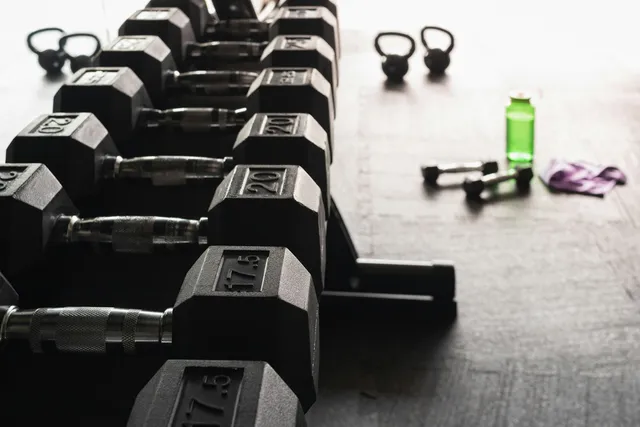
Think about the movements that fill a week rather than the one you post about.
Pressing and rowing take the heaviest loads, and those are the ones people size their purchase around. But lateral raises, rear delt work, curls, external rotation, every rehab movement and every warm-up set live in the bottom third of the range — and there are far more of those sets in a training week than there are heavy ones.
That rack in the picture is what a gym solves by owning fifteen pairs. At home you own one pair, and its increments decide whether the light movements progress at all.
This does not mean buy the lightest set. It means the top number is the wrong thing to optimise, and the step size is the right one.
What the sets actually do
Every product here was checked against its live listing on 27 August 2026.
| Product | Step size | Best for | Buy |
|---|---|---|---|
| PowerBlock Sport 24Our top pick | 3 lb, throughout | The finest steps at the bottom of the range | Check price → |
| BowFlex Results Series SelectTech Dumbbells | 2.5 lb to 25 lb | Fine where it matters, then coarser, and goes to 52.5 | Check price → |
| Core Fitness Adjustable Set | 5 lb | Reaches 50 lb, but jumps 5 lb even at the bottom | Check price → |
| Yes4All Spinlock Set | Whatever plate you add | Finest of all in principle — if you tolerate the changes | Check price → |
The one to buy if you train light and precisely
Best steps where it counts
PowerBlock Sport 24
- Range
- 3–24 lb per hand
- Increment
- 3 lb
- Adjustment
- Magnetic pin
- Warranty
- 5 yr residential
What we like
- 3 lb increments across the whole range, finer than any 5 lb set
- Eight settings from 3 to 24 lb per hand — the band most sets skip past
- Nothing to flex or crack: a pin through a block
- Small enough to live under a sofa rather than in a cradle
What we don't
- 24 lb per hand is a real ceiling and you will meet it on presses
- Not expandable, unlike the larger models in the same range
- The selector pin is plastic, and owners say so
- Both ends must click — seat one a block off and the dumbbell swings
The one to buy if you press seriously
The BowFlex holds 2.5 lb steps up to 25 lb and then widens. That is the right shape: fine where the small movements live, coarse where nobody notices. And it reaches 52.5, which the PowerBlock does not.
See the BowFlex listingBefore you buy either, two things worth five minutes: what breaks on them, and whether the listing is selling you one or two.
How to size it for yourself, in one session
You do not need a formula. You need one honest afternoon.
- Do a set of lateral raises to eight hard reps. Whatever weight that is, your set must reach below it and move in small steps around it.
- Do a set of one-arm rows to eight hard reps. That is roughly where your top end needs to be today.
- Add about 30% to the row number. That covers a year or two of progress, and it is a far better ceiling estimate than the biggest number on the box.
- Check the step size at the raise number, not at the row number. This is the check almost nobody makes.
- Ignore the marketing range. A set advertised to 200 lb total may sell you its lightest variant at the headline price.
Questions people ask
Is 24 lb per hand enough? For lateral raises, curls, rear delts, rotator work and most accessory training, comfortably, for years. For pressing and rowing, most people pass it inside a year of consistent training.
Should I buy heavier than I need now? A little. Roughly a third above your current hardest set is a sensible ceiling. Buying three times what you lift buys range you will not use and steps too coarse for the range you do.
Are 5 lb jumps really a problem? At 40 lb, no. At 10 lb they are a 50% increase, which is why the light movements are where people stall and quit — not because they lack discipline, but because the equipment offers them no next step.
Can I fix coarse increments? Partly: more reps, slower tempo, pauses. These work, and they are what you fall back on when the set is coarser than the movement. They are a workaround, not a substitute for a step you can actually take.
The percentages in the chart are plain arithmetic and can be checked with a calculator. Product step sizes and ranges are the manufacturers’ published figures, read from the live listings on 27 August 2026. The sizing method above is our own working approach, not a validated protocol, and it is offered as a starting point rather than a prescription. We do not buy or use this equipment. If a figure here stops matching the listing, tell us and we will correct it. More on the method in how we research, and more in Strength Equipment.
Specifications here are checked against the live listing on the date shown, and figures we derive ourselves are labelled where they appear.
How we research →