A Home Gym on Carpet
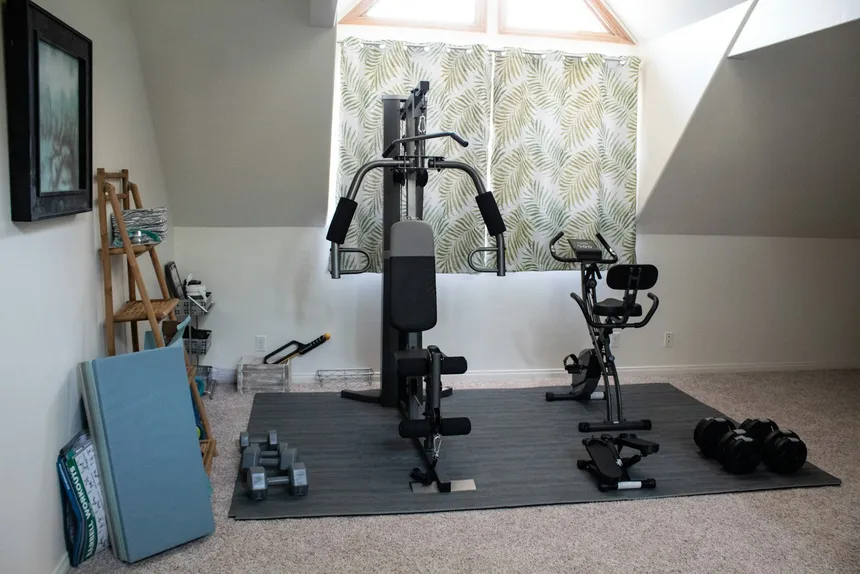
Carpet is the highest-rated impact floor in the building code's own scale — better than vinyl, better than a bare slab by about 30 points. It has already solved the neighbour. What it has not solved is holding anything level.
This guide contains affiliate links. Buying through one costs you nothing extra and pays for the research. As an Amazon Associate I earn from qualifying purchases. How this site is funded →
The room that would work is carpeted, and every answer you have found on the subject starts by telling you to rip it up.
So the plan gets more expensive and more permanent than the thing you actually wanted, which was somewhere to put a pair of dumbbells. And because it is now a flooring project rather than a purchase, it does not happen at all.
Here is what nobody leads with. On the scale the building code uses to rate a floor for the person underneath it, carpet is not the compromise. It is the best-performing surface in the table, by a distance, and it beats every hard floor you were about to install in its place.
Which means the question is not how to work around the carpet. It is what carpet is genuinely bad at — and that turns out to be something else entirely.
What this covers
Free weights, bands, a suspension trainer and one cardio machine, on ordinary domestic carpet with a cushion under it, in a room you are not going to renovate. Not a lifting platform, not a rubber gym floor, not a garage slab.
The floor figures below are published ratings from acoustic testing, not ours. The pressure figures in the second half are ours, and they are labelled where they appear.
Carpet has already won the argument you were worried about
Two different scales rate a floor, and they measure different problems. STC covers airborne noise — voices, television, music. IIC covers structure-borne noise: footfalls, dropped objects, furniture being dragged. Everything a downstairs neighbour ever complains about is on the second scale.
A bare six-inch concrete slab rates IIC 25 to 35. A wood joist floor with no insulation, which is what most flats above the ground floor actually are, rates 30 to 40. Both sit below the IBC minimum of 50 for multifamily housing. Vinyl plank over an underlayment — the upgrade people install — reaches 50 to 60.
Carpet with a cushion reaches 65 to 75.
That is roughly 30 points above the slab underneath it and 15 above the vinyl, on a scale where the convention is that ten points is heard as about half the sound. The soft floor you were planning to remove is doing more for the flat below than any product you could buy to replace it.
This does not make a carpeted room quiet. It makes it quiet downstairs. Carpet’s weakness is the other scale: it absorbs surface noise well and blocks airborne sound poorly, so a set of clanging plates still carries through the wall to whoever shares it with you — which is a different problem, handled in quiet home gym equipment for apartments.
And none of it changes the load the structure is carrying, which is a separate calculation and the one that actually has a limit in it.
What carpet is genuinely bad at
Carpet is a compressible layer between a rigid object and a rigid floor. That is exactly why it works acoustically, and exactly why it fails mechanically.
Standing on carpet, you load it at roughly 3 pounds per square inch, and it does not move, because your weight is spread across two shoes. A bench foot mid-set is carrying a comparable load through about a square inch and a half — call it 47 psi, more than fifteen times the pressure — and the pile under that foot compresses until it stops.
The consequence is not damage. It is that the compression is uneven and it happens under load. Four feet do not sink equally, so the bench arrives level and goes out of level with you on it. A bike’s stabiliser pads sink at the front under a hard effort and come back when you stop. Nothing breaks; the thing simply never sits still, and you spend the set correcting for it instead of lifting.
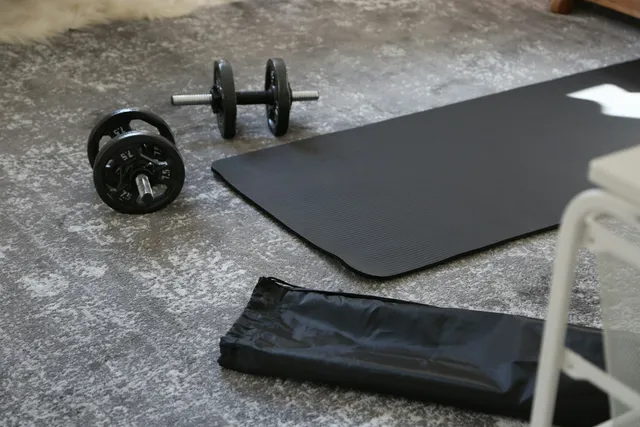
The second consequence is permanent, and it is the one that costs a deposit. A point load left in place for months crushes the pile in a way that does not recover — and unlike a scratch on a hard floor, there is nothing to sand. If you are renting, the no-drilling guide covers the rest of that problem.
The third is the one people get wrong in the other direction: a dropped plate does not bounce on carpet, it cuts it. Carpet has no give against a sharp steel edge arriving fast. The fibres part and the backing tears, and that is a repair rather than a mark.
So what actually changes about the buying decision
Three rules follow from the diagram, and they are all about contact area rather than weight.
Prefer things that sit on a broad base or no base at all. A kettlebell on its flat base, a pair of dumbbells lying on their heads, a band anchored to a door — none of them loads the pile hard enough to matter, because none of them concentrates the load.
Anything with four small feet needs a board, not a mat. A rubber mat spreads pressure a little and does nothing at all for levelness, because it is compressible too. What works under a bench or a bike is a rigid panel — a piece of plywood or MDF wider than the footprint — which turns four point loads into one distributed one. That is a hardware-shop purchase, not a gym one, and it is why no mat is recommended anywhere on this page.
Treat anything you might drop as ruled out rather than muffled. Carpet flatters a dropped weight acoustically and takes the damage instead. On a soft floor the honest rule is that the weight is placed down, not released — which quietly favours loads you can actually control, and is the same argument as how much weight you need.
The verdict
Best on a soft floor
BowFlex SelectTech 840 Kettlebell
- Range
- 8–40 lb
- Settings
- 6
- Adjustment
- Dial
- Impact risk
- Swings only
What we like
- Sits on a broad flat base: our estimate puts it at about the pressure of a standing person
- One object, so there is one indentation to worry about rather than a dozen
- Nothing to level — it does not care whether the pile compresses
- Sold and shipped by Amazon, so returns run through Amazon
What we don't
- Swings are the one movement where a soft floor stops helping and a drop cuts
- 8 to 40 lb over six settings is a coarse ladder, and it ends early
- The dial is a pinch point, and carpet gives you no warning when it topples
The BowFlex SelectTech 840 kettlebell wins here for an unglamorous reason: it has the largest contact patch per pound of anything in the catalogue, and no part of it needs to be level. On a floor whose only real fault is that it moves under concentrated pressure, an implement with no feet is the implement that does not notice.
The field
| Product | How it loads the pile | Best for | Buy |
|---|---|---|---|
| BowFlex SelectTech 840 KettlebellOur top pick | Flat base, one object | Broad base, nothing to level | Check price → |
| WHATAFIT Resistance Bands Set | No floor load | No contact with the floor at all | Check price → |
| TRX GO Suspension Trainer | No floor load | Load goes into the door, not the pile | Check price → |
| PowerBlock Sport 24 | Wide flat faces | Squared-off heads that sit flat | Check price → |
| BowFlex Results Series SelectTech Dumbbells | Wide flat faces | Range, if you place rather than drop | Check price → |
| Yes4All Spinlock Set | Sharp plate edges | Cheapest load, worst thing to drop | Check price → |
| pooboo Magnetic Belt-Drive Bike | Four small pads | Cardio, once it is on a rigid board | Check price → |
The carpet is staying and you are not building anything
Buy implements with no feet. A bell that sits on its own base and a set of bands that never touches the floor between them cover most of a session and put no lasting mark on the room.
Check the adjustable kettlebell Check the band setYou want a real dumbbell pair on a soft floor
Then buy the one with flat, squared-off faces rather than round plates, and place it down every time. Round plate edges concentrate the load into a line and are the shape most likely to cut the pile if one gets away from you.
Check the pin-selector pair Check the wider dial pairYou want cardio in a carpeted room
Buy the bike and buy a rigid board for it in the same week — the board is the part that makes it work, and it costs a fraction of the machine. A bike is also the one item here that transmits continuous vibration rather than impacts, which carpet does far less about than it does for a dropped weight.
Check the belt-drive bike Check the suspension trainerWhat breaks, and who fixes it
On carpet, the thing that fails first is usually the floor, not the equipment — and it fails quietly, over months, under a foot nobody looks at.
The equipment failure that matters most here is the plate set’s coating. Its listing sells a powder coat as the corrosion protection rather than the material, and a chipped edge on carpet does two things at once: it exposes cast iron, and it leaves the sharp face that cuts fibres. The full picture is in equipment maintenance and what breaks on adjustable dumbbells.
Returns: the kettlebell, both selector pairs and the plate set are sold and shipped by Amazon. The band set is sold by WHATAFIT LLC, the suspension trainer by TRX Training, and the bike by benrun — returns on those run through the seller.
Before you buy: five checks, thirty seconds each
- Press a thumb hard into the carpet where the kit will stand. If the dent takes more than a second to recover, a bench foot will not recover at all.
- Find out what is under it. Concrete behaves differently from joists, and the second one has a load limit worth reading about.
- Measure the footprint of anything with feet, then add four inches each way. That is the board you need, and it is easier to buy before the machine arrives than after.
- Check whether the carpet is yours. A crushed pile in a rented flat is a deposit conversation, and a landlord notices a rectangle of it.
- Decide now whether anything gets dropped. If the honest answer is yes, buy the implement you can place rather than the one you will release.
Questions people ask
Can you put a home gym on carpet? Yes, and acoustically it is the best floor in the building for the people below you — carpet with a cushion rates IIC 65 to 75 against 25 to 35 for a bare slab. The problem carpet creates is stability under small feet, not noise.
Do I need to rip up the carpet for a home gym? Not for free weights, bands or a bell. For anything with four small feet, a rigid board under the footprint solves the same problem for a fraction of the cost and none of the permanence.
Should I put rubber mats over carpet? A mat helps a little with pressure and not at all with levelness, because rubber compresses too. Under a bench or a bike, a rigid panel is what you want. A mat over carpet is mostly protecting the carpet, which is a real reason to buy one but a different one.
Will dropping weights damage carpet? Yes, and in the way people least expect: a plate edge does not crush the pile, it cuts through the fibres into the backing. Carpet sounds forgiving and is not.
Is an exercise bike alright on carpet? On a rigid board, yes. Directly on the pile the pads sink unevenly under effort and the frame rocks — and a bike transmits continuous vibration into the structure regardless of the surface, which is the one noise path carpet does least about.
Sources and method. Impact insulation class figures — bare six-inch concrete slab IIC 25 to 35, wood joist floor with no insulation 30 to 40, vinyl plank over underlayment 50 to 60, carpet with cushion 65 to 75, and the IBC multifamily minimum of IIC 50 — are from Commercial Acoustics, “IIC Rating 101”, read 2026-09-02. The distinction between IIC for structure-borne noise and STC for airborne noise is standard: Acoustical Surfaces.
Every pressure figure is ours, computed as load divided by contact area from the assumptions printed in the figure caption, and is an estimate rather than a measurement. It exists to make one point — that equipment feet load a floor an order of magnitude harder than a person does — and it should not be read as a specification for any product. Product specs and sellers were read from the live listings between 28 August and 1 September 2026. This site does not buy or use the equipment it ranks.
If you have crushed a carpet under a bench or cut one with a plate, tell us — that is the failure this page is trying to price.
More on how these are put together in how we research, and the rest of the cluster in Apartment Gyms.
Specifications here are checked against the live listing on the date shown, and figures we derive ourselves are labelled where they appear.
How we research →