A Home Gym Two People Can Share
Two people is a range problem, not a quantity problem — and only one implement on this page actually holds both of you. Sharing also doubles the one cost nobody prices in.
This guide contains affiliate links. Buying through one costs you nothing extra and pays for the research. As an Amazon Associate I earn from qualifying purchases. How this site is funded →
The conversation always goes the same way. One of you found the room, priced the kit and is ready. The other one says: would I actually use it?
And then, quietly, the real question. Because the two of you are not the same size, do not lift the same weight, and are not going to. So does one purchase serve both of you, or have you just agreed to buy a gym for one person and a coat rack for the other?
That question has an answer, and it is a number rather than a feeling.
What this covers
One shared setup for two adults in the same household, of different strengths, training in the same room. Not a commercial gym, not two separate setups in two rooms — the case where you buy once and both of you have to be able to use it.
The load figures below are published maximums read from the live listings on 28 August 2026. The two example lifters are illustrative and labelled as such; the point is the shape of the problem, not the exact pounds.
Two people is a range problem
Here is the mistake almost everyone makes. They think two people means buying twice as much. It does not. It means buying something wide enough, and width is a completely different specification from quantity.
Run the test and it thins out fast.
The pin-selector pair stops at 24 lb per hand. It covers the lighter lifter beautifully and the stronger one not at all. It is the pair we recommend for a solo beginner and for a fixed budget, and it is the wrong buy here.
The screw-collar set at its entry size starts around 20 lb per hand. It goes as heavy as you like, which is the reverse problem: the top is open and the bottom is too high for the lighter lifter to train with at all.
One dial-selector pair crosses both guides. That is the whole finding, and it is why the household case pushes you towards the widest range rather than the cheapest one.
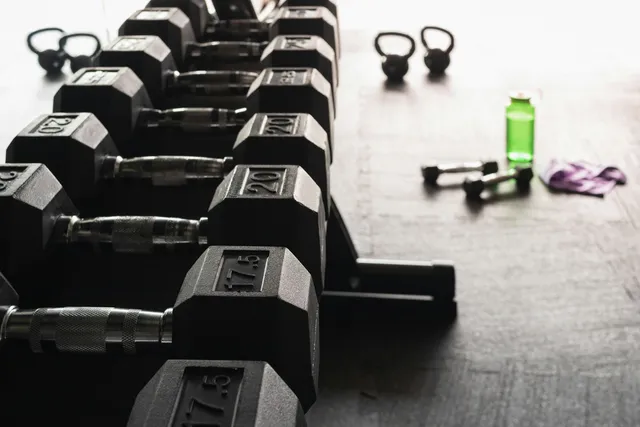
Worth being concrete about what the alternative costs. To cover 10 to 45 lb per hand in fixed dumbbells, in 5 lb steps, is eight pairs — sixteen objects, a rack to hold them and most of a wall. The photograph at the top of this page is what “two people, fixed weights” actually looks like.
That is the real comparison. Not one adjustable pair against another, but one adjustable pair against a rack.
The cost nobody prices in
There is a second thing sharing does, and it is invisible until you are living with it.
Training alone, you change the weight when the exercise changes. Sharing and alternating sets, you change it between every single set, because you are not on the same load as the other person. The number of changes in a session roughly doubles, and every one of them now has somebody standing there waiting for it.
Eight minutes. Not of training — of turning collars while the other one of you looks at their phone. Over a year of three sessions a week that is around twenty hours, and it is the single most reliable way to turn a shared gym back into a solo gym.
We costed this friction for one person in why home gym equipment goes unused. Sharing does not add a new problem, it doubles the existing one — which is why the argument that a fast mechanism is a luxury stops being true the moment two people use it.
Together, or in turns
Everything above assumes you alternate. If you intend to train at the same time, the arithmetic inverts completely and you should know which of the two you are before you buy.
In turns. One implement, as wide as you can get, as fast as you can get. The changeover is your main cost and the range is your main constraint.
At the same time. You need two of something, and now the cheapest adequate thing wins, because you are buying twice. This is the one case where a plate set plus a band set beats a single good pair: two people can both be working, and neither is waiting.
Most couples say the second and do the first. Be honest about which one you are — the wrong answer here costs more than any product choice on this page.
The pick
The only pair that holds two different people
BowFlex Results Series SelectTech Dumbbells
- Range
- 5–52.5 lb
- Increment
- 2.5 lb to 25 lb
- Adjustment
- Dial, ~3 sec
- Replaces
- 15 pairs
What we like
- Spans 5 to 52.5 lb per hand, which is the only range here containing both of our example lifters
- Steps of 2.5 lb at the light end, so two people can sit on genuinely different loads
- About three seconds a change, which matters twice as much when someone is waiting
- Sold and shipped by Amazon, so returns and warranty run through Amazon
What we don't
- The most expensive item on this page, and sharing is the argument that has to justify it
- One pair means one person trains at a time — it solves the range problem, not the queue
- Two objects that live out permanently
- Ranked from 234 ratings on this successor listing, the thinnest evidence base here
Being straight about the reasoning: this is the third guide on this site to land on this pair, and each time by a different route. What makes the household case the strongest of them is that the alternatives do not merely underperform — they exclude one of you. A pair that stops below your partner’s working weight is not a compromise, it is a pair your partner cannot use.
The field
| Product | Range per hand | Best for | Buy |
|---|---|---|---|
| BowFlex Results Series SelectTech DumbbellsOur top pick | 5–52.5 lb | The one range wide enough to contain two different lifters | Check price → |
| Core Fitness Adjustable Set | 5–50 lb | Nearly the same span in coarser 5 lb steps, from a brand that ships it itself | Check price → |
| WHATAFIT Resistance Bands Set | Up to 150 lb stacked | The second implement, so nobody is ever waiting | Check price → |
| Yes4All Spinlock Set | 20 lb and up | Two cheap setups instead of one good one, if you train simultaneously | Check price → |
| PowerBlock Sport 24 | 3–24 lb | Households where the gap between you is small and both of you are light | Check price → |
| BowFlex SelectTech 840 Kettlebell | 8–40 lb | Conditioning both of you can share, one at a time | Check price → |
| TRX GO Suspension Trainer | Bodyweight | The one thing that adjusts to each person by itself, in seconds | Check price → |
You train in turns, and the gap between you is real
Buy the widest pair and a band set. The pair covers both working ranges from one object; the bands give whoever is resting something to do, which is what actually stops the alternating session dragging.
See the dial pair See the band setYou want to train at the same time
Then you need two implements and cheap is the right answer twice over. A plate set for one of you and bands for the other, swapping between sessions, costs a fraction of a second good pair.
See the plate set See the band setRead the variant line before you pay — those listings state the weight as a total across both handles, not per hand, and that trap has its own guide in are adjustable dumbbells sold in pairs.
Both of you are starting, and neither of you is strong yet
Then the wide range is money spent on a future you have not reached. A light pair covers a genuine beginner household for a year or more, and the fine step at the bottom is worth more than the ceiling at the top — the arithmetic is in how much weight you actually need.
See the pin-selector pair See the TRX listingOne of you is committed and the other is not, yet
This is the most common household there is, and the honest advice is to buy small first. Straps and bands adjust to each person by themselves, take no floor and cost a fraction of a pair. If the second person turns out to train, upgrade then — nothing is wasted.
See the TRX listing See the band setThat staged approach is the whole of the first 90 days.
What breaks when two people use it
The selector, sooner. Every failure pattern in this category is a function of cycles, and a shared set does roughly twice as many. If a mechanism is rated for a number of adjustments, you are reaching it in half the time — what breaks on adjustable dumbbells covers where.
The agreement about putting it away. Shared equipment is left out by whoever finished last, and the resentment about that outlasts the equipment. Decide the storage spot before it arrives — the storage arithmetic is here.
The schedule, not the hardware. Two people alternating need roughly twice the session length for the same volume. If your evenings do not have that, you are back to training separately, and the whole set of trade-offs on this page changes.
Who you send it back to. Of the pairs here, the widest one is sold and shipped by Amazon; the runner-up is both sold and shipped by the brand itself, so delivery and returns both run through them.
Before you buy
- Both of you write down the weight you would use for a dumbbell press, for ten reps. Two numbers. Everything on this page follows from the gap between them.
- Check that gap against the ranges above, using your own numbers rather than our example ones. If both fit inside one implement, you have one purchase to make.
- Decide honestly whether you will alternate or train together. It changes the answer more than any product on the page.
- Agree the storage spot out loud, before it arrives.
- Count the evenings you both have free. A shared session is longer than a solo one, and that is the constraint people discover in week three.
Questions people ask
Should we just buy two cheap sets instead of one good one? If you train at the same time, yes, and it is not a compromise. If you alternate, no — you would be buying two objects, using one at a time, and still changing the weight between every set.
Is one pair really enough for two people? For alternating sets, yes, as long as its range contains both of you. That containment test is the whole guide.
What if one of us is much stronger? Then the range problem is the only one that matters, and the widest pair is not a luxury. Below about a 2x gap most pairs work; above it, almost none do.
Do we need two of everything eventually? Only the things you would both use in the same minute — a mat each, and a second cheap implement so nobody is idle. Not a second pair.
Can we share a kettlebell? Yes, and it is one of the better shared purchases, because a bell’s useful range is set by the movement as much as by the load. It is conditioning rather than strength, though — the comparison is in a kettlebell or dumbbells.
Product ranges are the manufacturers’ published maximums and the live listing fields, read on 28 August 2026. The two example lifters are illustrative rather than measured — substitute your own two numbers, which is the whole method the page is arguing for. The session figures are ours: six weight changes alone and twelve when alternating, with the per-change times taken from each mechanism’s published or measured adjustment figure. Of the products here, the top pick is sold and shipped by Amazon; the runner-up dial set is both sold and shipped by Core Home Fitness, and the band set and straps by their own brands, so returns run through them. We do not buy or use this equipment. We have deliberately not recommended a rack, a bench or a mat, because none has been verified. If something here stops matching, tell us and we will correct it. More on the method in how we research, and more of the same in Strength Equipment.
Specifications here are checked against the live listing on the date shown, and figures we derive ourselves are labelled where they appear.
How we research →