Home Gym Equipment for Seniors: The Step Matters More Than the Ceiling
Every adjustable dumbbell is sold on the top of its range. For someone starting in the teens per hand, the number that decides whether progress is even possible is the size of one increment — and below about 25 lb, none of them can do it.
This guide contains affiliate links. Buying through one costs you nothing extra and pays for the research. As an Amazon Associate I earn from qualifying purchases. How this site is funded →
You have been told to start lifting, by someone whose opinion you respect, and you agree with them.
Then you look at what you are supposed to buy, and every product page opens with a number you have no use for. Fifty-two pounds a hand. A hundred and five for the pair. Replaces fifteen pairs. None of that is aimed at somebody who would begin at twelve pounds and be pleased about it.
So the honest question — can I make this get gradually heavier without hurting myself — never gets answered, because the entire category advertises the wrong end of its range.
There is a spec that answers it. It is on every listing, nobody markets it, and once you see it the shortlist changes completely.
One safety fact first, because it belongs before anything else on the page. In June 2025 the CPSC announced a recall of 3,844,200 BowFlex 552 and 1090 adjustable dumbbells over weight plates dislodging from the handle, with 337 reports and 111 injuries (CPSC, June 2025). Anything selectorised should be checked against that notice before you buy it new or second-hand. The successor model named later on this page is not part of the recall — it is one of the remedies offered to owners of the recalled ones — but a plate leaving a handle mid-rep is a worse event at 70 than at 30, and that is reason enough to say it first.
What this covers
Strength equipment for someone starting or restarting in later life, training at home, in a room that is also used for something else. Not rehabilitation, not physiotherapy, not a prescription — if a joint or a heart is the reason you are here, that conversation belongs with a clinician and not with a buying guide.
What this page can do is the equipment question: what makes a piece of kit usable at loads under about thirty pounds a hand, and which of the things people recommend fail there for reasons that have nothing to do with strength.
The spec nobody advertises
Every adjustable dumbbell is ranked on its ceiling. The number that matters for a beginner is at the other end: how big the next step up is, relative to what is already on the handle.
The published recommendation is specific. The ACSM position stand on progression recommends that “a 2–10% increase in load be applied when the individual can perform the current workload for 1–2 repetitions over the desired number on two consecutive training sessions.”
Two to ten percent. Now put a real increment against a real starting load.
A five-pound step from fifteen pounds is a 33% jump. It does not enter the recommended band until you are lifting about fifty pounds a hand. A three-pound step is a 20% jump at fifteen pounds and reaches the band at about thirty. Even the finest increment on this site, two and a half pounds, is a 17% jump at fifteen.
Read the left-hand side of that chart honestly and it says something the category never admits: below about twenty-five pounds a hand, no adjustable dumbbell here can progress inside the recommended range. Not the cheap one, not the expensive one. The problem is not the product. It is that a fixed increment is a percentage that gets larger the lighter you are.
Which points at the answer. If the load has to move in small percentages and the hardware only moves in fixed pounds, then the first thing you buy should not set load in pounds at all.
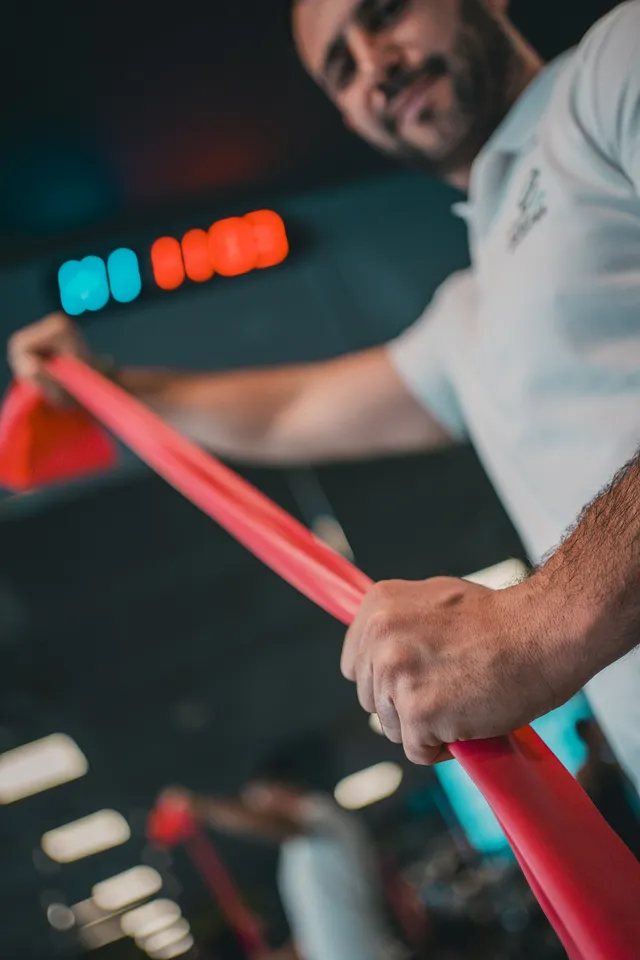
A band sets its tension by where you stand. Step six inches further from the anchor and you have added a few percent — a continuous variable, adjusted with your feet, with no smallest step. A suspension strap does the same thing with the angle of your body. Those are the only two continuously adjustable loads on this site, and the chart above is the reason they belong first rather than as an afterthought.
The dumbbells come later, when your working load has climbed to where their increments finally fit. That is not a compromise. It is the order the arithmetic actually implies.
The second constraint: what puts you on the floor
The other thing that decides this purchase has nothing to do with load either.
A great deal of home training assumes you will get down onto the floor and back up several times a session. For a lot of people that is the single hardest movement of the day, and if it is the price of admission to the workout, the workout stops happening.
Bands anchored to a door, and a strap anchored to the same door, are done entirely on your feet. Both selector pairs and the kettlebell work standing, and work sitting on an ordinary dining chair, which is the cheapest bench anyone owns and the subject of training without a bench.
The screw-collar plate set is the exception, and it is worth being blunt about, because it is the budget recommendation on half the pages of this site: loading and unloading plates happens at floor level, repeatedly, every time you change weight. Elsewhere its forty-second changeover is an inconvenience. Here it is forty seconds spent kneeling, several times a session, and that inverts the recommendation completely.
The bike is the other clean case — seated, no impact, and no cable to trip over, because its listing’s power source field reads battery powered rather than mains. That last detail matters more in this context than in any other, and it is covered in a home gym with nowhere to plug anything in.
What this rules out, and why
Anything you cannot put down safely. A load you can set down under control is a different object from one you have to drop at the end of a set. That rules towards implements you can lower rather than release, and away from training close to failure with free weight in your hands.
Anything whose lightest setting is not light. A pair whose range starts at five pounds and one that starts at ten are not the same product for this reader, whatever their ceilings say.
Anything selectorised that has not been checked against the recall notice. That includes second-hand units, which is where recalled stock keeps circulating — see buying second-hand.
The verdict
The only load you can adjust in single-digit percentages
WHATAFIT Resistance Bands Set
- Bands
- 10, 20, 30, 40, 50 lb
- Stacked
- Up to 150 lb
- Includes
- Door anchor, ankle straps
- Impact load
- None
What we like
- Tension is set by where you stand, so the step size is whatever you want it to be
- Every movement is done standing, with a door anchor included in the box
- No impact load, nothing to drop, nothing that can land on a foot
- Fits a drawer, so the room does not have to become a gym
What we don't
- You cannot read your load off a dial, which makes progress harder to record
- Natural rubber ages in storage whether or not you use it — it is on a calendar, not a use counter
- Sold by WHATAFIT LLC rather than Amazon, so returns run through the seller
- A band that slips off a door anchor comes back at head height
The WHATAFIT set tops this page on the one property the chart above demands and no dumbbell can offer: the load is continuous. You add a few percent by moving your feet, which is exactly the size of step the published guidance asks for and exactly the size no selector mechanism can produce.
It won on evidence volume as well — around 36,000 ratings, where most of the category sits in the hundreds — and this site ranks on aggregated owner reporting rather than spec sheets.
It is the first purchase, not the only one. The moment your working load is up around thirty pounds a hand, the increments on a pin-selector pair finally land inside the band, and that is the right time to buy one.
The field
| Product | Smallest step it can make | Best for | Buy |
|---|---|---|---|
| WHATAFIT Resistance Bands SetOur top pick | No fixed step | Continuous load, set with your feet | Check price → |
| TRX GO Suspension Trainer | No fixed step | Continuous load, set by body angle | Check price → |
| PowerBlock Sport 24 | 3 lb per step | The finest fixed step on a pin selector | Check price → |
| BowFlex Results Series SelectTech Dumbbells | 2.5 lb to 25 lb | The finest fixed step overall, at a price | Check price → |
| Core Fitness Adjustable Set | 5 lb per step | A dial you can read at a glance | Check price → |
| BowFlex SelectTech 840 Kettlebell | 6 settings, 8–40 lb | One object, carried in one hand | Check price → |
| pooboo Magnetic Belt-Drive Bike | 100 resistance levels | Seated conditioning, no floor work | Check price → |
| Yes4All Spinlock Set | Set by plate size | Fine steps, if kneeling is not an issue | Check price → |
You are starting from nothing and want to begin this week
Buy the continuous load and the door anchor that comes with it. Everything is done standing, the first session needs no assembly, and there is no step size to be defeated by.
Check the band set Check the suspension trainerYou are already lifting and want a pair that will not out-jump you
Then the increment is the whole specification. Three pounds a step is the finest on any pin selector here and it fits inside the recommended band from about thirty pounds a hand upward; the dial pair steps two and a half up to 25 lb, which is finer still, and costs well over half as much again.
Check the pin-selector pair Check the finer-stepping dial pairGetting down to the floor is the part you want to avoid entirely
Then buy one object that lives at hip height and one machine you sit on. Neither asks you onto the ground at any point, and between them they cover strength and conditioning in a room with a chair in it.
Check the adjustable kettlebell Check the belt-drive bikeWhat breaks, and who fixes it
The band set fails on a calendar, not a counter. Its listing’s material field reads natural rubber, which oxidises in a drawer whether or not anybody pulls on it — so it is the one item here that ages while you are not training, and the one to replace on a schedule rather than on appearance. The full three-clock picture is in equipment maintenance.
The failure that matters most for this reader is the selector, and it is the subject of the recall named at the top of this page: a plate leaving a handle mid-rep. Practically, the habit worth building is to check the selector has engaged fully before the weight leaves the floor, every time. More on which parts give out and when in what breaks on adjustable dumbbells.
Returns: both selector pairs and the kettlebell are sold and shipped by Amazon. The band set is sold by WHATAFIT LLC, the suspension trainer by TRX Training, the dial set by Core Home Fitness — which also ships it — and the bike by benrun. Returns on those four run through the seller, which is worth knowing before a heavy box arrives.
Before you buy: five checks, thirty seconds each
- Write down the load you would start at, honestly. Then find it on the chart above and see which increments are even usable there.
- Find the door you would anchor to. It has to close, and it has to open away from you. That one door decides whether the cheapest option on this page works at all.
- Sit on the chair you would use as a bench and put your arms overhead. If the back gets in the way, the seated column shrinks and standing movements matter more.
- Do one sit-to-stand from the floor, if it is safe to try. That is the movement half the internet’s home workouts assume, and it is the one that decides what you buy.
- Check the recall notice for anything selectorised, new or used, before you pay.
Questions people ask
What is the best home gym equipment for someone over 60? On the argument this page makes, a door-anchored band set first, because it is the only load that adjusts in the small percentages published guidance asks for, and because every movement is done standing. A fine-stepping dumbbell pair comes second, once your working load is up around thirty pounds a hand.
Are adjustable dumbbells good for older beginners? The good ones are, later. Below about twenty-five pounds a hand their smallest step is a 15 to 30% jump, which is outside the 2–10% the ACSM recommends — so they are the second purchase, not the first.
How much weight should I actually start with? That is a training question rather than a buying one, and it is covered separately in how much weight you need at home. What this page says is narrower: buy the thing whose steps fit where you are starting.
Is a plate set with screw collars a bad idea? For this reader, mostly yes, and not because of the weight. Changing it happens at floor level, several times a session — which is exactly the movement you are trying not to do repeatedly.
Is cycling enough on its own? It is excellent conditioning and it does nothing for the thing you were told to start lifting for. The seated bike is the companion to the strength work here, not a substitute for it.
Should I buy second-hand to keep the cost down? Not anything selectorised, and not without checking the recall notice first. Plates and a bike are different — what to inspect is here.
Sources and method. The progression figure is from the American College of Sports Medicine position stand Progression Models in Resistance Training for Healthy Adults, which recommends “a 2–10% increase in load … when the individual can perform the current workload for 1–2 repetitions over the desired number on two consecutive training sessions” (position stand, PDF), read 2026-09-02. Recall figures are from the CPSC notice of June 2025.
Increments are read from the live product listings; the percentages they produce, and the standing/seated/floor classification, are ours and are labelled as such on the figures. Product specs and sellers were read from the live listings between 28 August and 1 September 2026. This site does not buy or use the equipment it ranks, and nothing here is medical advice — if a joint, a heart or a recent injury is part of the picture, ask a clinician before adding load.
If you started later than most and found something on this list that did not work the way it reads, tell us.
More on how these are put together in how we research, and the rest of the cluster in Strength Equipment. If you are here for mobility outdoors as well, the electric trike guide for older riders is the other half of that.
Specifications here are checked against the live listing on the date shown, and figures we derive ourselves are labelled where they appear.
How we research →