Are Resistance Bands Enough? What They Replace and What They Don't
Bands are recommended to everyone with a small flat and defended by nobody who has hit their limits. Here is exactly where the resistance sits, what that means for building muscle, and the point at which you need real weight.
This guide contains affiliate links. Buying through one costs you nothing extra and pays for the research. As an Amazon Associate I earn from qualifying purchases. How this site is funded →
Everyone recommends bands to you, and nobody tells you when they stop working.
That is the frustrating part. The advice is “start with bands” — good advice — and then silence. So you either believe they replace weights entirely, which is wrong, or you dismiss them as a beginner toy, which is also wrong and costs you the most useful cheap purchase in the category.
The honest answer is specific rather than encouraging, and it comes down to one thing: where in the movement the resistance sits.
The curve is the whole argument
A dumbbell is loaded by gravity. The force it applies barely changes from the bottom of a press to lockout, because its mass does not change.
A band is loaded by stretch. The further it stretches, the harder it pulls.
Look at the left of that graph. At the bottom of a press — chest stretched, elbows low — the band is barely doing anything. That position is where a press produces most of its adaptation, and it is the position a band cannot load.
At lockout, the relationship reverses. The band is hardest exactly where the movement is mechanically easiest, which is why band pressing feels demanding and produces less than the effort suggests.
This is not a flaw. It is a different tool. It just means “150 lb of band” and “150 lb of dumbbell” are not the same purchase, and the number on the packaging invites you to think they are.
What bands genuinely replace
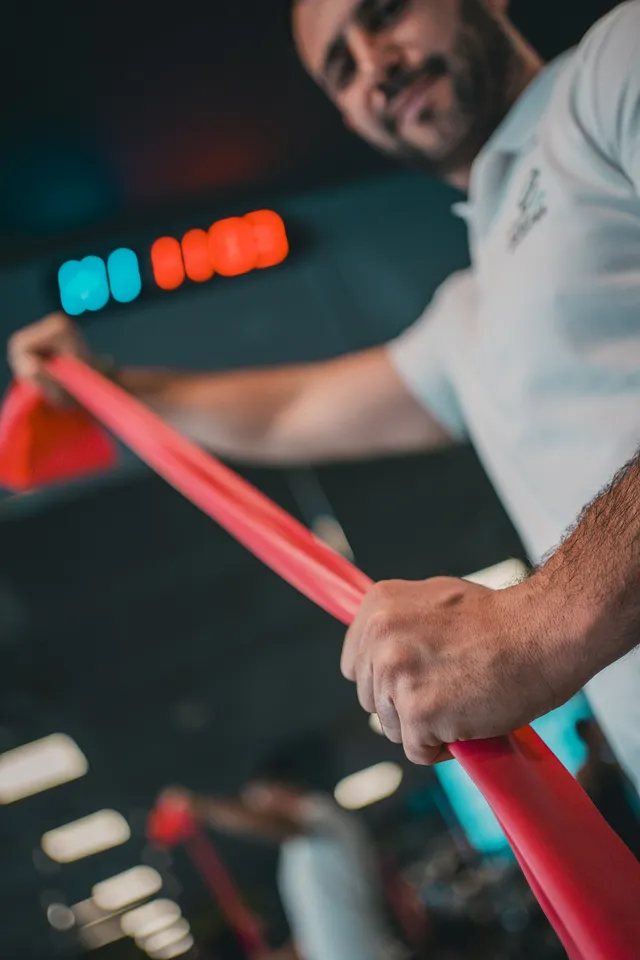
More than sceptics allow.
All pulling, well. Rows, face pulls, pull-aparts and every rear-delt movement suit the ascending curve, because those movements are hardest at the finish anyway. Bands and the resistance curve agree here.
Rotator cuff and rehab work, better than weights. Light, smooth, and no awkward joint angle at the bottom. This is the one category where physiotherapists reach for bands first, and it is not a compromise.
Every warm-up you will ever do. Even once you own a rack, this is what bands become, and it is why nothing you spend here is wasted.
Beginner pressing, for a while. In the first couple of months the limiting factor is coordination and connective tissue, not load. Bands clear that bar comfortably.
Anything at all when you are away from home. They weigh nothing and fit in a bag. No other tool on this site travels.
What they do not replace
Heavy pressing. The bottom of the range stays easy no matter which band you clip on. Stacking to 150 lb changes the top of the curve, not the bottom.
Loaded squatting. Getting a meaningful squat load through a band means standing on it and holding tension in a position that becomes the limiting factor before your legs do.
Progressive overload in small steps. Bands come in fixed resistances. Going up a band is a big jump — much bigger than the increments we argue for in how much weight you actually need — and there is nothing in between.
Anything requiring a fixed load. Because resistance changes through the range, the same “weight” is not the same at rep one and rep ten as fatigue changes your range. This makes honest progress tracking hard.
So when do you outgrow them?
Not on a date. On a symptom, and there are three.
- The bottom of your press feels like nothing while lockout burns. That is the curve telling you the tool has stopped matching the movement.
- You have moved to the heaviest band and are adding reps rather than resistance.
- You cannot tell whether you got stronger, because there is nothing to measure.
For most people training two or three times a week, that arrives somewhere in the second month. That is exactly the point at which we suggest adding dumbbells in the first 90 days.
What to buy
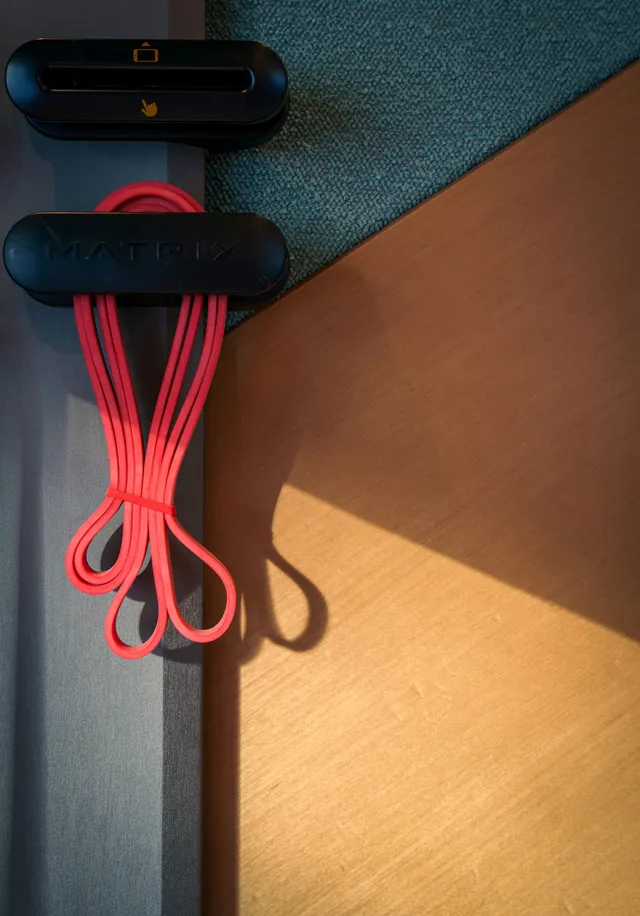
The band set is the pick, and it is not close on evidence: it carries the largest review base in the category by a wide margin, which matters on a site that ranks from aggregated owner reporting rather than testing.
| Product | What it loads | Best for | Buy |
|---|---|---|---|
| WHATAFIT Resistance Bands SetOur top pick | Rising to 150 lb | Pulling, rehab, warm-ups and travel | Check price → |
| TRX GO Suspension Trainer | Your bodyweight | The pulling angles bands reach worst | Check price → |
| PowerBlock Sport 24 | Constant, 3–24 lb | The first real load, in 3 lb steps | Check price → |
| BowFlex Results Series SelectTech Dumbbells | Constant, to 52.5 lb | When the press is the thing that stalled | Check price → |
Best bands, and the best first purchase in the category
WHATAFIT Resistance Bands Set
- Bands
- 10, 20, 30, 40, 50 lb
- Stacked
- Up to 150 lb
- Includes
- Door anchor, ankle straps
- Impact load
- None
What we like
- Five bands stacking to 150 lb, with the door anchor in the box
- Suits pulling and rehab better than dumbbells do
- Weighs nothing and travels — nothing else here does
- Stays in the rotation as warm-up work long after you outgrow it
What we don't
- The resistance curve leaves the bottom of a press unloaded
- Fixed resistances mean big jumps and no small increments
- Latex perishes: this is a consumable, not a lifetime purchase
- Progress is hard to measure, which makes stalling hard to spot
Add the straps rather than a second set of bands. They cover the pulling angles bands reach worst, and they hang off the same door.
See the TRX listingWhen the symptoms above appear, this is the step up — and the step size matters more than the top number.
See the PowerBlock listingGetting more out of the ones you own
- Anchor low for pressing. Pulling the band from below your shoulder puts more of its useful tension into the bottom of the movement.
- Add a pause at the bottom. It is the range the band cannot load, so load it with time instead.
- Stack two light bands rather than moving to one heavy one. It is the only way to get a smaller jump.
- Count total reps per week, not weight, because weight is not measurable here.
- Check for nicks before every session. A band fails suddenly and at your face. Latex that has gone chalky or shows a surface tear is finished.
- Keep them out of sunlight. UV is what kills them, not use.
Questions people ask
Can you build muscle with bands alone? Yes, particularly early on and particularly in pulling movements. What you cannot do indefinitely is progress, because the resistance steps are too large and the bottom of a press stays unloaded.
Are bands as good as weights? Wrong comparison. They are better for rehab and warm-ups, worse for heavy pressing, and roughly equivalent for rowing. Ask which movement, not which tool.
How long do they last? Latex is a consumable. Owners commonly report a year or two of regular use before a band goes, and UV exposure shortens that considerably.
Are the “150 lb” claims real? That is the stacked figure at full stretch, which is the most favourable possible reading. It is not what you experience at the bottom of a press, and the graph above is why.
Should I buy fabric or tube bands? Tube sets with handles and a door anchor suit pressing and rowing, which is what this guide is about. Fabric loop bands suit hips and glutes and are a different purchase.
The force curves in the diagram are schematic representations of how each tool loads a movement — the shape is accurate in principle, the values are illustrative, and the article says so rather than implying measurement. Product specifications are the manufacturers’ published figures, read from the live listings on 27 August 2026. We do not buy or use this equipment; picks are ranked from aggregated owner reporting. If a figure here stops matching, tell us and we will correct it. More on the method in how we research, and more in Strength Equipment.
Specifications here are checked against the live listing on the date shown, and figures we derive ourselves are labelled where they appear.
How we research →