Electric Trike Maintenance: The Bicycle List Is the Wrong List
A trike holds itself up in a corner with geometry instead of lean, which promotes half the bicycle maintenance list from comfort to safety — and there is one item on it that costs you rubber on every single corner, no matter how wide you take it.
This guide contains affiliate links. Buying through one costs you nothing extra and pays for the research. As an Amazon Associate I earn from qualifying purchases. How this site is funded →
Nobody services a machine they are not worried about.
That is the honest reason trike maintenance gets skipped. The thing stands up by itself. It does not fall over in the shed, it does not need leaning against anything, and everything about it communicates that it is fine. A bicycle nags you — it falls over, the chain comes off, the tyres go down and you notice at the first junction because the steering goes vague.
A trike is quieter about all of it. And the quietness is the problem, because on three wheels several of the things you are not noticing are not comfort items at all. They are the things that set how fast you can go round a corner.
What this covers
Upright adult electric trikes, ridden on road and path, owned rather than shop-serviced. This is about what to check and in what order, not about how to do a bottom bracket.
Where a number here is published, it says so. Where it is our arithmetic from published geometry, it says that too — and there is a piece of arithmetic further down that we think is the most useful thing on this page.
The list is sorted by the wrong question
Every bicycle maintenance guide sorts by interval: weekly, monthly, annually. That works on two wheels because the consequences of neglect are broadly proportional to how long you left it.
On three wheels the useful sort is different, because the machine cannot lean. In a corner a trike holds itself up with geometry alone, so anything that changes its geometry, its grip or its balance side to side is feeding straight into the one behaviour that actually bites.
Tyre pressure moves to the top, and it is not close. On a bicycle a soft tyre is slow and comfortable. On a trike a soft tyre squirms under cornering load — and cornering load is exactly the case where the machine has no lean to fall back on. We did that arithmetic in do electric trikes tip over: the threshold is around a quarter of a g, roughly 6 mph in a tight turn, and every bit of tyre compliance eats into it.
Brake balance joins it, which is a trike-only item. Two rear brakes that do not bite equally will pull the machine to one side under braking. On a bicycle you correct that with your body without noticing. On a trike you cannot, because you are not steering with lean.
Seat height is on the maintenance list at all, which surprises people. It is the one stability control the rider owns, it costs nothing, and it moves — somebody borrows the machine, somebody adjusts it to get a foot down, and it never goes back.
The thing that costs you rubber on every corner
This is the part we would keep if we could only keep one.
Go round a corner on three wheels. The outer rear wheel travels further than the inner one — it is on a bigger circle. If both rear wheels are driven at the same rate, one of them has to make up the difference by slipping, and it makes it up by dragging sideways across the tarmac.
Here is the arithmetic. The difference in distance is the track width multiplied by the turn angle in radians. Write that out and something falls out of it that most riders find genuinely surprising: the turn radius cancels.
An ordinary 90° street corner drags the rear tyres about forty inches across the road surface. Taking that corner slowly and wide does not help. Taking it three times as wide does not help. The only things in the expression are how far apart the wheels are and how far round you turn.
Twenty corners on a trip is something like 66 ft of tyre dragged sideways, every trip. That is where your rear tyres go, and it is why trike owners report rear tyre wear that makes no sense next to their bicycle experience.
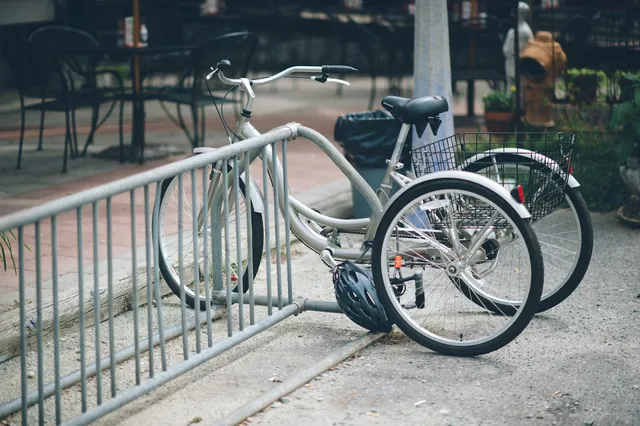
What removes it: a differential on the driven axle, which lets the two rear wheels turn at different rates. One machine in the range we follow publishes one. Driving only a single rear wheel also avoids the scrub, at the cost of the machine pulling to one side under power.
What the published data does not tell us: which of those two arrangements the other machines use. The spec tables name the differential where it exists and are silent where it does not, and silence is not evidence. So this is a question to put to a seller rather than a claim we will make for you — and if you ride a lot of tight turns, it is worth the email.
What the room does while nobody rides
The other half of the list runs on a calendar rather than on use, and it runs whether or not the machine leaves the garage.
Iron corrodes fastest above about 60% relative humidity, which happens to be the same number most indoor-air guidance gives as a ceiling for mould. Fix one and you have fixed the other — the most useful maintenance tool for a machine stored in a garage or a shed is a hygrometer rather than a can of oil.
We went through that threshold properly in home gym equipment maintenance, and the chemistry does not care that this object has wheels. Two trike-specific consequences:
The welds around the rear axle deserve a look twice a year. A trike’s rear axle cannot lean away from a bump, so one wheel takes a hit the other does not and the twist goes into the frame. In December 2025 the CPSC recalled about 400 fat-tyre trikes from another maker after sixteen reports of a hairline weld fracture. That, and what else has been actioned in this category, is on our trike recalls page.
The battery ages on the calendar, not on your odometer. Nothing in a maintenance routine stops that. Storing it somewhere temperate slows it, which is the whole reason every maker in this category says to charge indoors.
The verdict
The highest-value maintenance purchase for a trike is not a tool kit. It is the thing that lets you do the top item on the left-hand column in ninety seconds without thinking about it.
The one that changes how the machine handles
BV Floor Pump with Gauge
- Max
- 160 psi
- Valves
- Presta and Schrader
- Gauge
- Yes
What we like
- Around 30,436 ratings, one of the largest samples in our whole catalogue on any site
- Gauge on the pump, so pressure becomes a number you read rather than a thumb press
- Reversible head takes both Presta and Schrader, which matters if you have never checked which valve you have
- Rated to 160 psi, far beyond anything a trike tyre needs, so it is never working hard
What we don't
- Ships from Amazon but is sold by a third party, so returns run through them
- A floor pump is a garage object — it does nothing for you at the far end of a ride
- Does not tell you what pressure to run; that is on the tyre sidewall
- Three tyres means three checks, and people reliably do two
The field
| Product | What it maintains | Best for | Buy |
|---|---|---|---|
| BV Floor Pump with GaugeOur top pick | Pressure, all three tyres | The single check that changes how the machine behaves today | Check price → |
| MoonCool TK Pro Electric Trike | Driven-axle differential | Removing the corner scrub at source rather than replacing tyres for it | Check price → |
| Puroma Waterproof Bike Cover | Keeps weather off | A machine that lives outside, in the 2-bike size a trike actually needs | Check price → |
| MoonCool Mirrors (Pair) | Two mirrors | Seeing what is behind you without twisting against a seat you cannot lean off | Check price → |
| MoonCool TK2 Pro Electric Trike | 36.2 in seat ceiling | Keeping the one free stability control from being set badly | Check price → |
You want the fortnightly routine to take five minutes
A pump with a gauge and a pair of mirrors, and then the routine is: three pressures, both brakes pulled hard while stationary, a shove sideways on each wheel to feel for bearing play, and a look at the seat clamp. That is the whole left-hand column.
See the floor pump with a gauge See the mirrors, sold as a pairIt lives outside, and that is not changing
Then the cover is the maintenance, and it needs to be the two-bike size — cover sizes are named by number of bicycles, and a trike is about the footprint of two parked side by side. Put a hygrometer wherever it stands, and bring the battery indoors.
See the two-bike cover See the floor pump with a gaugeYou are still choosing the machine, and you have read this far
Then buy the differential if you can, because it is the one item on this page you cannot retrofit and the only one that removes a wear mechanism rather than managing it. Everything else here is a habit and a twenty-dollar tool.
See the trike with the differential See the low-seat trikeWhat actually fails, in order
Tyre pressure, constantly. It is the only item on the machine that degrades measurably between one fortnight and the next.
Rear tyres, faster than you expect. See the scrub arithmetic. This is a consumable on a trike in a way it is not on a bicycle.
Brake pads, unevenly. Two rear brakes rarely wear at the same rate, and the imbalance shows up as a pull long before either pad is finished.
Bearings, quietly. A trike carries more weight than a bicycle and does not tell you when a bearing is rough, because you are not feeling the road through a lean.
The battery, on the calendar. Years, not miles.
The frame, rarely and seriously. Welds near the rear axle, twice a year, in daylight.
Before your next ride
- Check all three tyres, not the two you can see from where you park it.
- Pull both brake levers hard while standing over it and feel whether the machine tries to turn.
- Shove each wheel sideways at the top of the tyre. Any knock is bearing play.
- Look at the seat height and put it back where it belongs if it has moved.
- Look at the rear welds, both sides, once a season, with a torch.
- Put a hygrometer where it is stored, if that place is a garage or a shed. It is the cheapest thing on this page and it decides the corrosion question for you.
Questions people ask
How often should I check tyre pressure on an electric trike? Fortnightly, and before any ride carrying a load. It is the top item because it changes handling rather than lifespan.
Why do the rear tyres wear so fast on a trike? Because both rear wheels are on different circles in every turn. If they are driven together, one has to scrub — about forty inches per 90° corner, and taking the corner wider does not reduce it.
Does a differential fix that? Yes, that is exactly what one is for. One machine in the range we follow publishes one; the spec tables do not say what the others do.
Do electric trikes need more maintenance than bikes? Not more items, but a different order of priority — and one extra wheel, one extra tyre and one extra brake to check.
Can I leave it outside all winter? Under a cover, with the battery indoors, if the humidity where it stands is not sitting above 60%. A hygrometer answers that better than a rule of thumb.
What pressure should the tyres be? Read the sidewall of the tyre you actually have. We are not going to publish a number for a tyre we have not seen.
Sourcing. The 28.4 in total width used to derive the 25.4 in track, the driven-axle differential on one model, and the geometry behind the cornering threshold are MoonCool’s published specifications, read from their product pages on 29 August 2026. The scrub figures are our arithmetic — track width times turn angle in radians — and they assume both rear wheels turn together; where a differential is fitted, or where only one rear wheel is driven, they do not apply. We do not know which arrangement every model in the range uses, because the spec tables name the differential where it exists and are silent otherwise, and we have not treated that silence as evidence. The 60% humidity threshold and the corrosion curve are covered with their sources in home gym equipment maintenance. The weld recall is CPSC notice 26-152 of 18 December 2025.
Nothing here has been serviced or measured by us. If you have worn out a set of rear tyres and the mileage does not match this, tell us — that is real data and we do not have any. More on how we research, and the rest of the cluster is in electric trikes.
Specifications here are checked against the live listing on the date shown, and figures we derive ourselves are labelled where they appear.
How we research →