Do Electric Trikes Tip Over?
Yes, and the federal regulator has already warned about it on one model. But nobody publishes the number that matters — the speed, in a turn of a given size, at which a three-wheeler runs out of geometry. It is arithmetic, it is on every spec sheet, and it is lower than the machine's own top speed.
This guide contains affiliate links. Buying through one costs you nothing extra and pays for the research. As an Amazon Associate I earn from qualifying purchases. How this site is funded →
You went looking at three-wheelers for one reason. Two wheels had started to feel like something you manage rather than something you just do, and a third wheel looks like the end of that.
Then you found the comment. Someone under a video, or three pages into a forum thread, saying theirs went over on a corner. And now you are stuck, because the machine you were buying for safety turns out to have a failure mode you had not budgeted for.
The answer is yes, they tip. That is not a rumour and it is not rare.
What almost nobody will give you is the number — the speed, in a turn of a given size, at which it actually happens. It is not a secret. It is arithmetic you can check on a calculator, from figures the manufacturers already publish, and it comes out lower than you would guess.
The regulator has already said it out loud
On 15 January 2026 the U.S. Consumer Product Safety Commission warned consumers to immediately stop using Liberty Trike 16-inch and 20-inch electric tricycles because they “can tip over during turning, creating a risk of serious injury from falls,” and said the risk is heightened on slopes or uneven surfaces. CPSC investigated six reports of falls causing injuries including concussions, fractures and contusions. About 7,490 units were sold between October 2015 and November 2025. The warning is here.
Read the next sentence of that notice carefully, because it is the part that matters to you as a buyer: the importer, Electric Bike Technologies, has not agreed to recall them, and has told the regulator it cannot afford to offer a remedy. CPSC’s advice to owners is to stop riding and dispose of the machine.
A separate action three weeks earlier covers a different failure: on 18 December 2025 Pedego recalled about 400 Fat Tire Trikes because the frame can develop a hairline fracture near a weld and the tubes separate. Sixteen reports of a frame breaking, one leg laceration. That notice is here.
Two different problems, and it is worth separating them now. A cracked weld is a manufacturing defect: some trikes have it, most do not, and a recall fixes it. Tipping in a turn is not a defect. It is a property of having three wheels, it applies to every upright trike ever built, including the one this page ends up recommending, and no recall will ever remove it.
So the useful question is not whether yours will tip. It is at what speed, in what size of turn — and what you can do about it.
What this covers
Upright adult trikes with one wheel at the front and two behind, the step-through kind bought for stability rather than sport, electric or not. Recumbent tadpole trikes — two wheels at the front, a seat a few inches off the ground — behave differently and better in turns, and none is verified here. Cargo trikes and children’s trikes are out of scope.
Every dimension below is a published manufacturer figure. The two things we estimate — where a rider’s centre of mass sits, and how high it sits — are labelled as ours each time they appear.
A bicycle cannot do this at all
This is the part that gets lost. A two-wheeler and a three-wheeler do not just differ in stability; they fail in different ways, and only one of them has a rolling failure.
A bicycle leans. Its two contact patches make a line, and in a turn the rider leans until the combined pull of gravity and cornering falls along that line. There is no sideways tipping mode to find, because the machine simply rotates until the forces balance. Push a bike past its limit and the tyres let go and it slides — which happens at ground level, at a speed you can feel building.
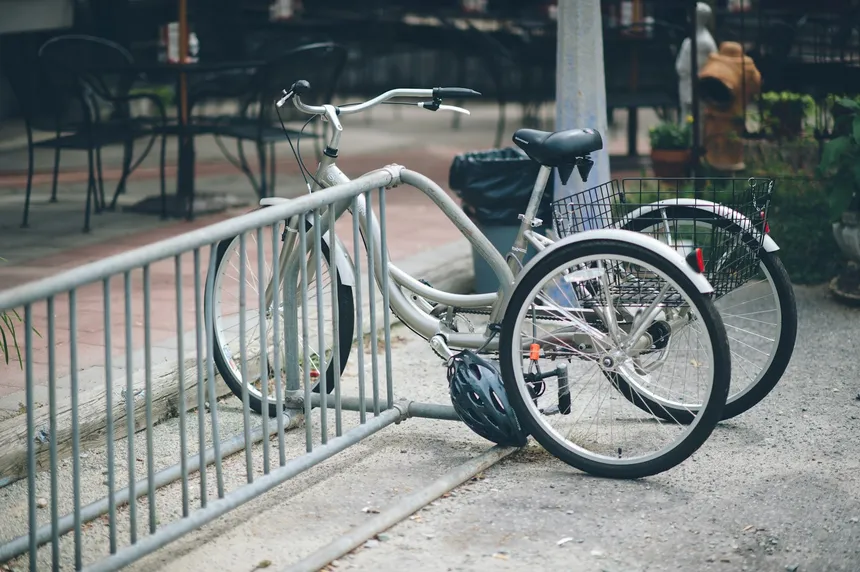
A trike cannot lean. Three contact patches make a triangle, the frame is rigid, and so cornering force has to be resisted by geometry alone. Past a limit, the machine rotates about the edge of that triangle and the inside rear wheel comes up.
Now the bit that surprises people who have measured the width of their trike and felt reassured.
You do not get half your track width. You get the diagonal. On the geometry above — a published 28.4 in total width, so about 25.4 in between tyre centres, and a 44.1 in wheelbase — half the track is 12.7 in, but the perpendicular from the centre of mass to the tipping edge is about 8.8 in. A third of the stability you thought you had bought is not there.
This is why comparing trikes on width alone is close to useless, and why a wider machine is worth less than the tape measure suggests.
The number

Put the lever over the height of the centre of mass and you get the fraction of gravity the machine can resist sideways before it rolls. For a seated adult on a trike of this class, with the seat mid-range, that works out at roughly a quarter of a g. A passenger car sits near 1.3. An SUV near 1.1.
From there it is one line of school physics. Cornering acceleration is v² / r, so the speed at which it rolls is the square root of (0.25 × 9.81 × the turn radius).
Read the crossing point, because it is the whole article. This class of machine does not reach its own published top speed of 15.5 mph until the turn is about 64 feet across. A residential street corner is a fifth of that. A driveway U-turn is smaller still.
Which means the sentence a spec sheet will never print: it can go faster than it can corner, and nothing on the machine tells you where that line is. No warning light, no wobble, very little feel. The first sign is the inside wheel leaving the ground.
That is also exactly what the regulator described — tipping in turns, worse on slopes and uneven ground. It is not one bad brand. It is the shape.
Four things move that line, and you control three of them
Seat height, which is the big one. Raising the seat from the bottom of its range to the top lifts your centre of mass and costs roughly a fifth of the tipping margin — about ten per cent off the speed you can safely corner at. Every model publishes its seat range. Almost nobody reads it as a safety number, and it is the most powerful one on the page.
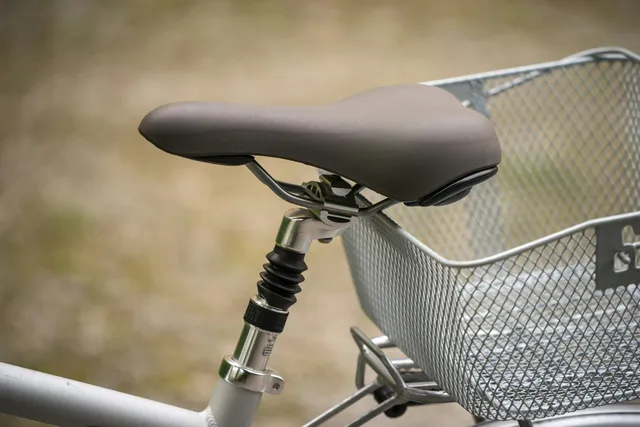
Where you put the shopping. A loaded rear basket sits high and behind the rear axle, which raises the centre of mass and shifts it backwards, and shifting it backwards shortens that diagonal lever again. Heavy things go low and forward. This is free.
Leaning in. You are roughly two-thirds of the combined mass, so shifting your weight into the turn moves the whole centre of mass inboard and buys real margin back. This is the technique every trike manual describes in one line and no one practises. Practise it somewhere flat.
Grip, which you do not control, and which cuts the other way. Everything above is the rigid-body limit — it assumes the tyres hold. If they let go first, the trike slides instead, and sliding is by far the better failure. So a loose gravel path is, counter-intuitively, more forgiving than dry tarmac, and fat, grippy tyres make a tip more likely rather than less, because they are better at refusing to slide. Wider tyres buy you a better track and a worse failure mode at the same time.
The verdict
Nothing on the market removes the tipping mode. What differs is how much margin the geometry starts with, and the four models here are close enough that only two figures separate them: the width between the wheels, and how high the seat can be set.
The most margin to start with
MoonCool FT1 Fat Tire Electric Trike
- Total width
- 30.7 in
- Wheelbase
- 51.2 in
- Seat height
- 30-40 in
- Max load
- 400 lb
What we like
- Widest track and longest wheelbase in the range, which is the best roll geometry of the four on our numbers
- Its seat tops out lower than the flagship, so the worst-case centre of mass is lower too
- Every dimension needed to check this yourself is published — total width, wheelbase, stand-over and seat range
- Lifetime frame warranty, two years on the battery, one year on parts
What we don't
- Its 4-inch tyres grip hardest, so on dry tarmac it is the model most likely to tip rather than slide
- Rated to 400 lb, fifty pounds under the rest of the range — check that against your weight plus shopping
- The advantage over the others is real but small: geometry buys single-digit percentages, seat height and technique buy more
- Nineteen reviews is not an owner-report sample, so nothing here is ranked on how it has held up
One thing to be clear about, since this is a safety page. We found no recall and no CPSC warning covering this range at the time of the check below. That is not evidence that it is immune to anything on this page — the arithmetic above applies to it exactly as it applies to every other upright trike.
The field
| Product | Roll geometry | Best for | Buy |
|---|---|---|---|
| MoonCool FT1 Fat Tire Electric TrikeOur top pick | 30.7 in wide, seat to 40 in | The widest track and longest wheelbase, so the most margin before it rolls | Check price → |
| MoonCool TK2 Pro Electric Trike | 27.6 in wide, seat to 36.2 in | The lowest seat ceiling in the range, which caps the mistake you are most likely to make | Check price → |
| MoonCool TK2 Folding Electric Trike | 29 in wide, seat to 39 in | Folding, if the machine has to get through a door — not if it has to be lifted | Check price → |
| MoonCool TK Pro Electric Trike | 28.4 in wide, seat to 42.1 in | The longest legs and the most range, at the highest centre of mass here | Check price → |
| MoonCool POP Folding Electric Bike | Two wheels — no roll mode | Anyone who can still balance, because leaning removes this failure entirely | Check price → |
Put those two published figures together and the same answer falls out for every model on the list, which is why this page keeps coming back to the seatpost rather than the badge.
Every bar is wider than the distance between the bars. Dropping the seat on the worst machine here buys more stability than swapping it for the best one — and it is free, reversible, and takes a minute with an Allen key. Choose on geometry if you like, then go and do the thing that actually moves the number.
You are buying three wheels because balance is the problem
Then you are making the right trade, and you should make it with your eyes open: you are removing the problem of staying upright while stopped and starting, and accepting a new one in corners. Take the widest track you can, and set the seat as low as you can still pedal properly.
See the fat-tyre trike See the low-seat modelYou can still balance, and you are buying for range or for carrying things

Then buy two wheels. This is the recommendation that costs us the larger commission and it is still the right one: a two-wheeler has no rolling failure at all, it is narrower through gaps, and the baskets and the motor are available on it just the same. A trike is the answer to a balance problem. If you do not have a balance problem, it is a solution looking for one.
See the two-wheeled folding bike See the trike insteadIt has to get through a door, or into a car
The folding model is the one built for that, and here is the part the word “folding” hides: it weighs about 99 lb. Folding changes its shape, not its mass. If the plan involves lifting it into a boot, that plan needs two people or a ramp, and you should decide that before you buy rather than in a car park.
See the folding trike See the non-folding versionYou are at the tall end of the size range
Every model here quotes the same 5 ft to 6 ft 3 in rider range, but they get there with different seat heights, and a tall rider ends up sitting higher on all of them — which is precisely the condition that costs stability. If that is you, the model whose seat cannot be raised as far is doing you a favour, not short-changing you.
See the low-seat model See the longest-legged modelWhat breaks, and who fixes it
The Pedego notice above is the useful warning about this whole category: on a trike the frame carries loads a bicycle frame never sees, because the rear axle cannot lean away from a bump. Welds near the rear of the frame are the place to look, and a hairline crack there is the failure that does not announce itself.
The range recommended here is sold direct rather than through a marketplace, which cuts both ways: there is no third-party seller in the middle, and equally there is no marketplace returns desk behind it either. The published cover is a lifetime frame warranty, two years on the battery and one year on parts, with free replacement parts, shipping by FedEx or UPS, and the programme is United States only. Everything in that sentence is the manufacturer’s own claim, not something we have tested by making a claim on it.
For how we keep the record on safety notices, and why a recall notice almost never reaches the second owner of anything, see our running record of equipment recalls.
Before you buy, and before your first ride
- Pace out the tightest turn you actually make. The end of your drive, the turn into the garage, the corner at the end of the road. Nine feet is a driveway U-turn. Twenty is a street corner. Then read them off the chart above.
- Set the seat as low as you can and still pedal properly. Do it on day one, before the habit sets. It is the single largest safety adjustment on the machine.

- Check the rider-height range against your inside leg, not your height. Two people the same height need different seat positions, and only one of those numbers is on the spec sheet.
- Check the load rating against your weight plus a full basket, not against your weight.
- Put heavy shopping low and forward. Never high in the rear basket if you can avoid it.
- Ride the first week on flat, uncambered ground, and take every corner slower than feels necessary until you have found what the machine does.
- Practise leaning into turns somewhere with nothing to hit. It is the one technique that buys back real margin, and it is not instinctive if you have ridden a bicycle all your life.
- Search the model against the CPSC database before you pay, and again if you buy second-hand — the Liberty Trike warning above is not a recall, so nobody is obliged to contact owners.
Questions people ask
Do electric trikes tip over? Yes, in turns, above a speed set by their geometry — and on our arithmetic that speed is below the top speed the motor will give you. The federal regulator has issued a public warning about exactly this on one brand.
Are trikes safer than bicycles for older riders? They are safer at the thing that usually stops people cycling — balancing while stopping, starting and standing — and less safe in corners. That is a different risk profile, not a smaller one. If balance is not your problem, two wheels is the safer machine.
Is a wider trike more stable? Yes, but by less than the number suggests, because the edge it rolls over is the diagonal, not the track. Width helps; it does not help proportionally.
Does the electric motor make tipping worse? Not directly — it changes nothing about the geometry. What it changes is how easily you arrive at a corner carrying a speed you would never have pedalled up to, especially on the flat and downhill.
What about a recumbent or tadpole trike? Two wheels at the front and a seat a few inches off the ground is a genuinely more stable arrangement in turns, for both reasons at once: a longer effective lever and a far lower centre of mass. We have none verified, so we are not recommending a model.
Can I make it wider? No. Changing an axle or fitting a wider rear end alters the load path the frame was designed around, and it ends your warranty. Lower the seat instead — it is free and it does more.
Three wheels, and I still have to worry about corners. Is it worth it? For a lot of people, yes, and plainly so: a machine you can stop at a junction without putting a foot down is a machine you will actually ride. The point of this page is not to talk you out of it. It is that the cornering limit is a number you can know in advance instead of finding by accident.
The tipping warning is CPSC’s own, dated 15 January 2026, covering about 7,490 Liberty Trike 16-inch and 20-inch electric tricycles sold by Electric Bike Technologies between October 2015 and November 2025, with six investigated reports of falls causing concussions, fractures and contusions, and no recall agreed — read it in full. The frame recall is CPSC 26-152, dated 18 December 2025, about 400 Pedego Fat Tire Trikes, sixteen reports of frame breakage and one laceration — read it in full. Every dimension quoted — total width, wheelbase, stand-over, seat range, load rating and top speed — is the manufacturer’s own published figure, read off the live product pages on 29 August 2026. The centre-of-mass height, its position along the wheelbase, and therefore the quarter-of-a-g figure and every speed derived from it, are our estimates, built from published geometry and stated so you can redo them with your own weight: the method is the perpendicular distance from the centre of mass to the front-to-outside-rear diagonal, divided by centre-of-mass height. We do not buy or ride this equipment, we have not tipped anything over to check, and with review counts running from two to sixty-seven we have deliberately not ranked anything on owner reports. If a figure here stops matching what the manufacturer publishes, tell us and we will correct it. More on the method in how we research, the rest of the category is in Electric Trikes, and if you are weighing this against exercise you can do without going outside at all, that is cardio in a flat, without a treadmill.
Specifications here are checked against the live listing on the date shown, and figures we derive ourselves are labelled where they appear.
How we research →