Electric Trikes and Hills: You Are Worrying About the Wrong Half
Climbing is a power-at-speed problem, and the arithmetic says these machines will climb almost anything slowly. The half nobody asks about is the way down, where gravity works with you and a trike's one real limit is a speed limit.

This guide contains affiliate links. Buying through one costs you nothing extra and pays for the research. As an Amazon Associate I earn from qualifying purchases. How this site is funded →
There is a hill between you and everywhere useful.
You know its exact character — where it kicks up, the bit near the top where you have to stand on the pedals, the way you have arrived somewhere for years slightly out of breath. And the whole reason you are looking at a motor is that hill.
So the question you are asking is: will it get me up.
It will. That part is arithmetic and we will show you the arithmetic. The question worth your attention is the one nobody asks, which is what happens on the way back down — because that is where a trike behaves least like the bicycle you learned on.
What this covers
Upright adult electric trikes on ordinary road gradients, up to about 12%. Off-road climbing, loose surfaces and mountain gradients are out of scope.
The machine figures here are published. The physics is standard and we show the working, so you can check it rather than take it. Where a figure is our assumption — rider weight, drivetrain efficiency — the drawing says so on its face.
Going up is a power problem, not a motor problem
Holding a steady speed up a slope takes a predictable amount of power: the weight you are lifting, times the steepness, times how fast you insist on doing it. Nothing else.
A 6% gradient — a proper hill, the kind you notice on foot — asks for about 286 W at 8 mph. Even 12%, which is steep enough that you would change your route on a bicycle, asks about 573 W against gravity.
Those are not big numbers for these machines. And notice the line: even the steepest bar sits under the 750 W federal continuous ceiling we went through in is an electric trike street legal.
But read the last line of the drawing, because it is the whole answer: power scales with speed. Every figure doubles if you want to do the same hill at 16 mph. So the honest sentence is not “it climbs 12%”. It is:
These machines will climb almost anything you point them at. What they will not do is climb it fast. If you expect to hold 15 mph up a long 8% grade, you will be disappointed by any of them, and the disappointment will be thermal rather than mechanical — a long climb is exactly where the difference between a peak rating and a continuous rating stops being a legal footnote and becomes something you can feel as the motor heats and the controller pulls back.
Climbing costs less battery than you think
The other half of the hill worry is range, and here the arithmetic is genuinely reassuring.
A hilly local loop with 300 ft of climbing in it costs about 4% of the largest battery here. A seriously hilly day of 1,000 ft costs about 15%.
That surprises most people, and it is worth understanding why: lifting a weight is a one-off payment, while pushing through air and rolling resistance is a payment you make continuously for every mile. Elevation is cheap. Speed and stop-start riding are expensive. If your range is disappointing, the hills are rarely the reason — we went through what actually is in electric trike range.
Now the half nobody asks about
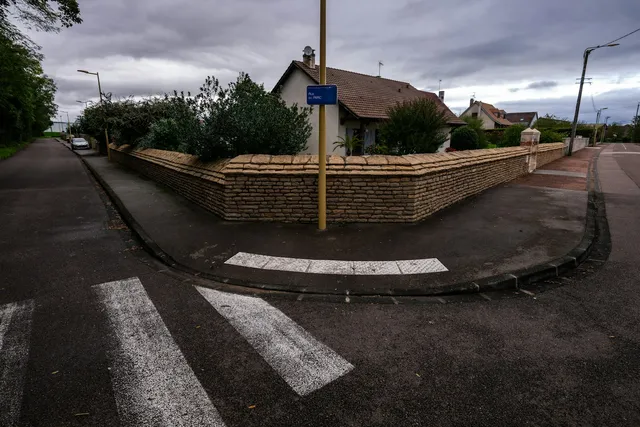
Here is where a trike stops resembling the machine you learned on.
Going down, gravity is doing the work, and it does not get tired. Your speed rises on its own until something stops it, and the thing that has to stop it is a brake on a 99 lb machine carrying you.
On a bicycle that is a familiar situation, and if you overcook a corner at the bottom you lean harder. A trike cannot lean. In a turn it holds itself up on geometry alone, and past a threshold it rolls over the diagonal from its front contact patch to the outside rear wheel.
We did the arithmetic in do electric trikes tip over. It comes out around a quarter of a g, which is roughly 6 mph in a tight turn — and a junction at the bottom of a hill is precisely where you arrive faster than you intended.
So the hill that matters is not the one that makes you breathe hard on the way up. It is a hill with a corner at the bottom of it, and that is a sentence worth carrying away from this page even if you buy nothing.
Two practical consequences:
Seat height matters more on a hilly route than a flat one. It is the one input to the roll threshold you control, it is free, and it is worth more on descents than any specification difference between models.
Brakes are a maintenance item, not a feature. Two rear brakes that bite unequally will pull the machine sideways under hard braking — which on a descent is when you are braking hardest and can least afford it. That is on the fortnightly list in electric trike maintenance for this reason.
The verdict
For hills you want the bigger motor for the climb and the lowest seat for the descent, and one machine here is at the top of both lists.
Best on a hilly route, in both directions
MoonCool TK2 Pro Electric Trike
- Total width
- 27.6 in
- Wheelbase
- 43.3 in
- Seat height
- 29.5-36.2 in
- Max load
- 450 lb
What we like
- Peak 1310 W with a 48V 20Ah battery, the upper motor and battery tier in this range
- Lowest seat ceiling here at 36.2 in, which is the one roll-stability control a rider owns and the one that matters on a descent
- Shortest wheelbase of the 450 lb machines at 43.3 in, which makes a tight turn at the bottom of a hill less of an event
- 12.6 in stand-over, among the lowest published, which matters when you stop mid-climb
What we don't
- Narrowest track in the range at 27.6 in, so the least cornering margin — the seat height is doing the work here, not the width
- No continuous power rating is published, and a long climb is exactly where that number would matter
- Nothing in this range is sold with a published gradeability figure, so climbing claims cannot be compared between makers
- Twenty reviews at the time of checking, so this is ranked on published specifications
The field
| Product | Peak motor output | Best for | Buy |
|---|---|---|---|
| MoonCool TK2 Pro Electric TrikeOur top pick | 1310 W peak | Hilly routes in both directions — top motor tier, lowest seat ceiling | Check price → |
| MoonCool TK Pro Electric Trike | 1310 W peak | The same motor and battery with a differential, for hills with corners in them | Check price → |
| MoonCool FT1 Fat Tire Electric Trike | 1092 W peak | The widest track and longest wheelbase, for descents on cambered lanes | Check price → |
| MoonCool TK2 Folding Electric Trike | 1092 W peak | A smaller battery on a folding frame, if the hills are short | Check price → |
| MoonCool POP Folding Electric Bike | 1200 W peak | Two wheels, less weight to lift up the hill and no roll limit on the way down | Check price → |
The hill is long and you will be on it for a while
Take the top motor and battery tier, and accept that you will be climbing at 8 mph rather than 15. A long climb is a thermal question, and the machine that is working least hard is the one with the most in reserve.
See the low-seat trike See the other 1310 W trikeThe hill is short but there is a junction at the bottom

Then the descent is your actual problem and the answer is mostly free: set the seat as low as you can still pedal properly, brake before the corner rather than in it, and treat the bottom of every hill as a place you arrive faster than planned.
The helmet is on this page for the same reason it tops our recalls page — the documented injuries in this category are concussions and fractures from sideways falls, and a descent is where the speed comes from.
See the low-seat trike See the helmetYour route is hilly and full of turns
Then the corner scrub matters twice over — it wastes energy you are already spending on the climb. The machine with the published differential is the one that does not pay it.
See the trike with the differential See the floor pump with a gaugeThe hill is the only reason you are buying
Be honest about whether the problem is the hill or the balance. If you can still put a foot down at a junction without thinking about it, two wheels climb the same hill with less weight to lift and have no roll limit at the bottom.
See the folding electric bike See the low-seat trike insteadWhat gives way on a hilly route
Brake pads, faster than on the flat, and unevenly. Descending is where they do their work.
Motor temperature on a long climb, which shows up as the assist quietly reducing rather than as a failure. That is the controller protecting itself and it is normal.
Tyre pressure, which matters twice here — once for the rolling resistance you are paying on the way up, once for the grip you want on the way down.
Your own confidence, in the wrong direction. The machine climbs so easily that riders arrive at descents faster and more often than they used to. That is the actual behaviour change a motor produces, and it is worth naming.
Before you buy
- Measure the gradient of your hill rather than guessing. A phone levelling app on the road surface takes ten seconds and most “steep” hills are 5 to 7%.
- Note what is at the bottom of it. A straight run-out is a different purchase from a T junction.
- Count the total climbing on your usual ride, in feet, on any mapping app. Then look at the battery chart above and stop worrying about it.
- Decide what speed you actually need uphill. If 8 mph is fine, everything here is fine.
- Set the seat low before the first descent, not after it.
- Test the brakes on the flat, hard, and feel whether the machine tries to turn.
Questions people ask
Can an electric trike climb steep hills? Yes, slowly. Against gravity a 12% grade at 8 mph needs about 573 W on our example weights, which is well inside these machines. Holding a high speed uphill is the thing they will not do.
What gradient can an electric trike handle? No manufacturer here publishes a gradeability figure, so nobody can give you a verified number. The power arithmetic above is the honest substitute.
Do hills kill the battery? Much less than people expect. 1,000 ft of climbing is around 15% of a 960 Wh battery. Speed and stop-start riding cost far more.
Is going downhill on a trike dangerous? It is the part that deserves your attention. A trike cannot lean, so its cornering limit is a speed limit, and a descent supplies speed you did not ask for. Brake before the corner.
Should I worry about the motor overheating on a long climb? Expect the assist to reduce rather than the machine to fail. No continuous power rating is published in this category, which is the number that would answer this properly.
Does a heavier rider struggle more on hills? Proportionally, yes — the power needed is directly proportional to total weight. Add a fifth to the weight and you add a fifth to the demand.
Sourcing. Peak motor outputs of 1310 W, 1200 W and 1092 W, battery capacities, seat ranges, track widths and wheelbases are MoonCool’s published specifications, read from their product pages on 29 August 2026. No manufacturer in this category publishes a continuous power rating or a gradeability figure, and we have not estimated either. The climbing power figures are standard physics — weight times gradient times speed — using a 300 lb machine-plus-rider example that is ours, and they exclude rolling resistance, drivetrain losses and air, so the real demand is higher. The battery-cost figures are weight times height at an assumed 80% drivetrain and motor efficiency, which is our assumption and is stated on the drawing. The quarter-of-a-g roll threshold is derived in do electric trikes tip over.
We have not ridden any of these up anything. If you have measured your hill and your consumption, tell us. More on how we research, and the rest of the cluster is in electric trikes.
Specifications here are checked against the live listing on the date shown, and figures we derive ourselves are labelled where they appear.
How we research →