Electric Trike Tyres: Why the Back Ones Wear Out First
A three-wheeler drags its rear tyres sideways in every single turn, and the arithmetic says taking the corner wider does not help. One machine in this range publishes the part that removes it. The rest of the spec tables are silent.
This guide contains affiliate links. Buying through one costs you nothing extra and pays for the research. As an Amazon Associate I earn from qualifying purchases. How this site is funded →
You noticed it about eight months in. The back tyres look older than the front one, and it makes no sense, because the front one does the steering and takes the braking and lives a harder life by every intuition you have about bicycles.
Then you looked closer and it was worse than uneven wear. There is a scuffed, feathered look across the tread that you have never seen on a bicycle tyre in your life.
That is not a defect and it is not your riding. It is arithmetic, it happens on every corner you have ever taken, and there is exactly one spec in this category that removes it.
What this covers
Tyres, pressure, wear and punctures on an adult electric trike. Not tyre brands — no tyre is a verified product on this site — and not tubeless conversions.
The geometry below is the makers’ own published figures. The scrub arithmetic is ours, and it is the same calculation the maintenance guide runs.
Why the back tyres go first
Two rear wheels sit either side of an axle. Go round a corner and the outer one has further to travel than the inner one — a longer arc around the same centre.
If both wheels are forced to turn at the same rate, that difference cannot come out in rotation. It comes out as the tyres dragging sideways across the road surface, and that drag is what feathers the tread.
The expression is simply the track width times the turn angle in radians. A right-angle turn on a 25.4 in track drags each rear tyre about 3.3 ft sideways. Twenty corners on an ordinary errand run is around 66 ft of pure sideways scrubbing.
Now look at what is missing from that expression: the radius. It is not in there. Taking the corner wide does not reduce the scrub at all — only turning through a smaller angle does.
That is worth sitting with, because it kills the most natural piece of advice anyone would give you. You cannot ride around this. You can only buy around it.
The one spec that removes it
A differential lets the two rear wheels turn at different rates, which is exactly what the corner is asking for. With one fitted, the scrub goes to zero.
Across this range, a differential is published exactly once. The 28.4 in machine states a speed differential on the driven axle, and its own description notes that most machines in the bracket do not have one.
Every other spec table in the range is silent on the question.
Silent is not the same as absent, and this page will not pretend otherwise. What it means is that for four of these machines you cannot answer the tyre-wear question from published data, and the honest instruction is to ask the seller before you buy rather than to assume either way.
There is a third possibility worth knowing, because it produces a different symptom: some three-wheelers drive only one rear wheel. That removes the scrub too, and replaces it with a pull to one side under power. If a machine tracks straight and eats rear tyres, both wheels are driven. If it pulls but the tyres last, one is.
Pressure does more than the spec sheet
Everything above is geometry you cannot change. Pressure is the variable you can, and on these machines it does more work than it does on a bicycle.
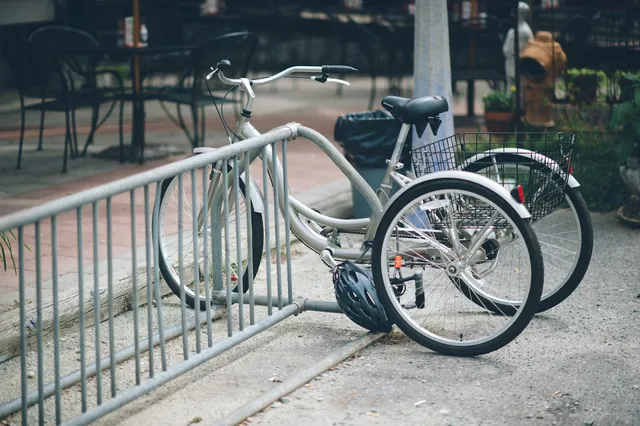
Three reasons. The published payload is up to 450 lb on most of this range, which is far more than a bicycle tyre normally carries. The machine itself is 99 lb before anyone sits on it. And a soft tyre has a larger contact patch, which means more rubber available to be scrubbed sideways in every one of those corners.
So underinflation on a trike is not just slow — it is directly and measurably expensive in tread. Check pressures with a gauge rather than a thumb, and check them fortnightly rather than when something feels wrong.
The other reason to check is that with three wheels you cannot feel a soft one. On a bicycle a low tyre announces itself in the steering. On a trike the machine stays upright and level and tells you nothing at all.
A puncture is a different job
This is the part people discover at the worst moment.
A bicycle repair quietly assumes you can turn the machine upside down. You cannot lift 99 lb, so every rear-wheel job needs something to raise the frame instead — and that is before the motor cable and the axle get involved.
The practical position: carry what fixes a front wheel, and plan a phone call for the back ones. A driven rear wheel on a machine this heavy is usually a workshop job, and getting the machine there is its own problem.
The verdict
The only one that publishes the part that saves the tyres
MoonCool TK Pro Electric Trike
- Total width
- 28.4 in
- Wheelbase
- 44.1 in
- Seat height
- 30.3-42.1 in
- Max load
- 450 lb
What we like
- States a speed differential on the driven axle — the one spec here that removes rear-tyre scrub
- Its own description notes most machines in this bracket do not have one
- 44.1 in wheelbase and 28.4 in total width, so the geometry is documented in full
- 450 lb published max load, and 48V 20Ah — the largest pack in the range
What we don't
- Highest seat in the range at 42.1 in, which is the worst case for roll stability
- Only 67 published reviews — ranked on specifications, not owner reports
- Still 99 lb, so a rear puncture is still not a roadside repair
- Wider than the narrowest machine here, which matters if it has to pass a 30 in door
The MoonCool TK Pro takes this page on a single published line in its spec table that no other machine in the range carries. On a page about what wears your tyres out, the machine that publishes the component which stops it wearing them out is not a close call.
The trade is real and belongs here rather than in a footnote: this is also the machine with the highest seat in the range, and seat height is the variable the tipping guide cares about most. Better tyres, worse roll geometry.
The field
| Product | Rear axle, as published | Best for | Buy |
|---|---|---|---|
| MoonCool TK Pro Electric TrikeOur top pick | Speed differential, stated | The published differential | Check price → |
| MoonCool TK2 Pro Electric Trike | Not stated — ask | Lowest seat, best against roll | Check price → |
| MoonCool FT1 Fat Tire Electric Trike | Not stated — ask | Widest track, biggest contact patch | Check price → |
| MoonCool TK2 Folding Electric Trike | Not stated — ask | Shortest wheelbase to manoeuvre | Check price → |
| MoonCool POP Folding Electric Bike | No second rear wheel | Two wheels, so no scrub at all | Check price → |
Your route is full of junctions and you will do a lot of corners
Buy the published differential. Scrub is per corner rather than per mile, so a short trip with twelve turns costs your tyres more than a long straight run.
Check the TK Pro Check the TK2 ProRoll stability worries you more than a tyre bill
Then buy the low seat and accept the tyres as a running cost. Tyres are replaceable; geometry is not, and a machine that tips is a different category of problem from a machine that scrubs.
Check the TK2 Pro Check the FT1You can still balance a bicycle
Then none of this applies to you at all. A two-wheeler leans into the corner instead of dragging through it, and there is no scrub because there is no second rear wheel — which is one more entry on the list of things a trike solves that you may not need solved.
Check the two-wheeler Check the folding TK2What breaks, and who fixes it
Rear tyres, and sooner than the front. That is the headline and it is structural rather than a fault.
The pattern to look for is feathering — tread blocks worn to a sloped edge, all in the same direction, across the whole width. That is scrub. Ordinary wear from braking and load is even and central, and appears on the front first. If you have feathering on the rear and a clean front tyre, the drivetrain is telling you both wheels are driven together.
The second failure is the one nobody plans for: you will need two rear tyres at once, because they wear at the same rate for the same reason. Budget for a pair rather than for one, and check availability for your specific size before you need it — these are sold direct rather than through a bike shop, so a spare is an order rather than a trip.
Returns and parts: the machines here are sold by the manufacturer, so tyres, tubes and a warranty claim all run through the same company.
Before you buy: five checks, thirty seconds each
- Ask the seller whether the rear axle has a differential. If the spec table does not say, this is the single most useful question you can ask before ordering.
- Ask whether both rear wheels are driven. One driven wheel removes the scrub and adds a pull; two driven together does the opposite. Both are liveable, and you should know which you bought.
- Buy a gauge, not a thumb. Three wheels hide a soft tyre completely, and a soft tyre scrubs more rubber every corner.
- Check what a replacement pair costs and whether the size is stocked for that model, before you own it.
- Count the junctions on your usual route. Scrub is charged per corner, not per mile, and that is what decides whether the differential is worth paying for.
Questions people ask
Why do my electric trike’s rear tyres wear out so fast? Because both rear wheels are almost certainly driven at the same rate. In every turn the outer wheel has further to travel than the inner one, and the difference is dragged sideways across the road — about 3.3 ft per right-angle corner on a typical track.
Does taking corners wider help? No, and this is the counterintuitive part. The scrub works out as track width times turn angle; the radius cancels out. Only turning through a smaller total angle reduces it.
How do I know if my trike has a differential? Usually by asking, because most spec tables in this class do not mention it. One machine in this range publishes one. If your rear tyres feather evenly and the machine tracks straight, both wheels are driven together and there is no differential doing its job.
What tyre pressure should I run? Whatever the sidewall and the maker specify, checked with a gauge every couple of weeks. A trike carries far more payload than a bicycle and hides a soft tyre completely, so guessing costs more here than it does on two wheels.
Can I fix a puncture at the roadside? On the front wheel, yes, like any bicycle. On a driven rear wheel, usually not — you cannot invert a 99 lb machine, and the motor cable and axle are in the way.
Should I replace one rear tyre or both? Both. They wear at the same rate for the same structural reason, so a single replacement just puts you back a few months later.
Sources and method. Track widths, wheelbases, payloads, net weights and the differential statement are the manufacturers’ own published specifications, read from the spec tables on 2026-08-29. Where a spec table is silent on the rear axle, this page says so rather than inferring an answer — four “not stated” rows on the chart are four questions for a seller, not four negatives.
The scrub arithmetic is ours: track width times turn angle in radians, taking the track as the published 28.4 in total width less one 3.0 in tyre, which gives 25.4 in centre to centre. The puncture classification is ours as well, from the published 99 lb net weight and the drivetrain layout. This category is ranked on published specifications rather than owner reports, because review counts across the range run from 2 to 67. No tyre, tube, pump, sealant or repair product is recommended anywhere on this page, because none is verified.
If your own rear tyres have lasted much longer or much less than this suggests, tell us — and say whether the machine pulls to one side, because that is the tell.
More on how these are put together in how we research, and the rest of the cluster in Electric Trikes.
Specifications here are checked against the live listing on the date shown, and figures we derive ourselves are labelled where they appear.
How we research →