How Much Can an Electric Trike Actually Carry?
The number on the spec sheet is a total, not a rider limit, and it is the generous constraint. The one that bites first is where the load sits — because the same forty pounds is a different machine in a rear basket than in a front one.
This guide contains affiliate links. Buying through one costs you nothing extra and pays for the research. As an Amazon Associate I earn from qualifying purchases. How this site is funded →
The reason most people look up this number is not curiosity. It is a quiet, private worry that they are too heavy for the thing, and that they will find out in front of somebody.
So they find “450 lb max load” on the spec sheet, feel a wave of relief, and stop reading.
That relief is mostly justified and it is being taken from the wrong number. The rating is a total for everything the machine holds up — you, your coat, the helmet, the lock bolted to the frame, the shopping, the dog. And it is not the limit you will meet first anyway. The limit you will meet first is not written on any spec sheet, because it depends on where you put the load rather than how much of it there is.
What this covers
Upright adult electric trikes rated between 330 and 450 lb, carrying a rider plus ordinary shopping — bags, a crate, a case of something heavy. Cargo trikes with a box between two front wheels are a different machine and are out of scope.
Every rating quoted here is a manufacturer’s published figure. The budget we build out of those ratings is an example and it is ours; it is labelled that way wherever it appears.
What is actually left after you get on
Start by spending the number rather than admiring it.
On a 450 lb machine a 200 lb rider in ordinary clothes with a rack, a lock and a pair of mirrors fitted has something like 220 lb left. That is an enormous margin for shopping. You would have to be carrying a person to use it up.
On a 330 lb machine — the two-wheeler in this range — the same rider has about 100 lb left, which is still more than most people ever carry but is no longer a number you can ignore.
So for the great majority of readers, the rated payload is not your constraint and you can stop worrying about it. Which is the useful half of the answer, and it means the rest of this page is about the constraint that actually binds.
The widest machine carries the least
Before that, one thing in the published data worth knowing, because it cuts against the intuition everybody arrives with.
The machine with the best roll geometry in the range — widest track, longest wheelbase, the one we picked in do electric trikes tip over — is rated fifty pounds lower than the other three.
That is not a contradiction, it is a reminder that these two properties are set by different parts. Cornering margin comes from track and wheelbase. Payload comes from the frame, the welds, the axle and the wheels. A maker can build a wide, stable machine on a lighter-rated axle, and here one has.
The practical version: if you are a heavier rider who also wants the most cornering margin, you are being asked to choose, and nobody selling these will tell you that.
The limit that binds first is height, not weight
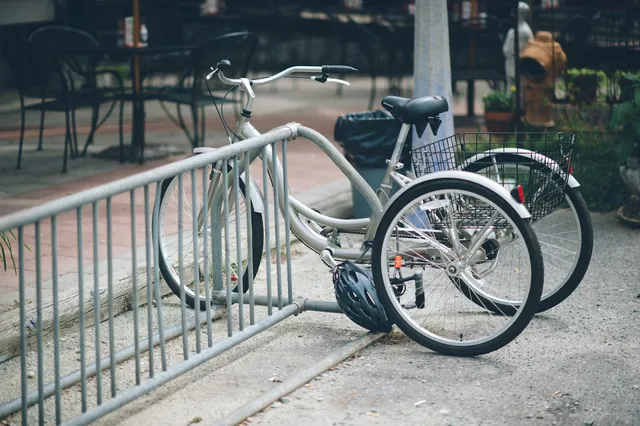
Here is the mechanism the rating cannot describe.
A trike does not lean. In a turn its weight has to be held up by geometry alone, and it rolls over the diagonal from the front contact patch to the outside rear wheel. We drew that edge to scale and did the arithmetic: it comes out around a quarter of a g, which is roughly 6 mph in a tight turn.
That threshold is a ratio between how far apart the wheels are and how high the combined weight sits. Track is fixed at the factory. Height is not: it is set by your seat position and by where you put the shopping.
Which means forty pounds of load is two different purchases depending on where it goes:
In a rear basket, above and behind the axle, it sits high. It raises the combined centre of mass, and everything about the machine’s behaviour in a corner gets worse — not dangerously, but measurably, and in the direction you least want.
Low and forward — a front basket, panniers hung beside the rear wheels, a crate strapped down at axle height — the same forty pounds barely moves the combined centre of mass at all.
We are deliberately not going to hand you a number for this. Doing it properly needs the machine’s own centre-of-mass height, and no manufacturer in this category publishes one. What we can tell you without inventing anything is the direction and the rule of thumb it produces: low and forward beats high and behind, every time, and the difference is bigger than the difference between any two models here.
The verdict
For carrying, the machine to want is a 450 lb rating on a long wheelbase, with the load sitting as low as you can arrange it.
Best for carrying loads
MoonCool TK Pro Electric Trike
- Total width
- 28.4 in
- Wheelbase
- 44.1 in
- Seat height
- 30.3-42.1 in
- Max load
- 450 lb
What we like
- Rated 450 lb total, the top of this range
- 44.1 in wheelbase, the longest of the 450 lb machines, which helps under a shifting load
- Carries a speed differential on the driven axle — the rear wheels can turn at different rates in a corner, which most machines in this bracket do not offer
- Lowest published stand-over here at 12.2 in, which matters when you are mounting a loaded machine
What we don't
- Highest seat ceiling in the range at 42.1 in, and seat height is the one stability lever you control
- 28.4 in of total width will not pass a 30 in interior door once trim is allowed for
- The published rating is a total, and it includes every accessory bolted to the frame
- Sixty-seven reviews at the time of checking, which is the largest sample here and still not owner reporting
The field
| Product | Rated total load | Best for | Buy |
|---|---|---|---|
| MoonCool TK Pro Electric TrikeOur top pick | 450 lb | Carrying, on the longest wheelbase of the 450 lb machines | Check price → |
| MoonCool TK2 Pro Electric Trike | 450 lb | The same rating with the lowest seat ceiling, so the load sits lower | Check price → |
| MoonCool TK2 Folding Electric Trike | 450 lb | The same rating on the shortest wheelbase, for tight storage | Check price → |
| MoonCool FT1 Fat Tire Electric Trike | 400 lb | The most cornering margin here, at fifty pounds less capacity | Check price → |
| MoonCool POP Folding Electric Bike | 330 lb | A rider who carries little and does not need three wheels | Check price → |
You are a heavier rider and that is the whole question
Take a 450 lb machine and stop worrying. Even at the top of the rider range there is room for a week of shopping, and the frame rating is not what will limit your riding. Set the seat as low as you can still pedal properly — that adjustment does more for how the machine feels than the model choice does.
See the long-wheelbase trike See the low-seat trikeYou will do the weekly shop on it
Then buy the capacity and then buy a pump, and we mean that in order of importance rather than as a joke. Load goes straight into tyre pressure, and a soft tyre under load squirms exactly where you least want compliance — in a corner, which is the load case the whole tipping argument is about.
Pressure is also the one maintenance item that changes how the machine handles rather than how long it lasts. Check it fortnightly if you carry anything.
See the long-wheelbase trike See the floor pump with a gaugeYou want the stability and the capacity
You are choosing, and the honest framing is which you would rather give up. The widest machine here gives up fifty pounds. The 450 lb machines give up some cornering margin, which you can partly buy back for nothing by lowering the seat.
Our reading: take the 450 lb machine and lower the seat, because seat height is free and axle rating is not.
See the low-seat trike See the widest-track trikeThe load is going in a car as well as on the trike
At 99 lb these do not lift into a boot, and folding changes their shape rather than their mass. A rack sized for a trike is the only verified answer we have here — and its fitment, hitch class and rated capacity are not published in the catalogue data, so check those on the listing before you buy rather than taking our word for it.
See the trike carrier rack See the folding trike insteadWhat gives way, and where
Payload does not fail all at once. It shows up in four places, in this order.
Tyre pressure, immediately. A loaded machine on soft tyres feels vague long before anything is at risk.
Brakes, on a descent. Stopping distance scales with mass, and a loaded trike descending is the one situation where these machines ask more of their brakes than a bicycle ever does.
Spokes and the rear wheel, over months. Load lives on the rear axle, and the rear wheel is where fatigue accumulates.
The frame, rarely and seriously. A trike’s rear axle cannot lean away from a bump, so one wheel takes a hit the other does not and the twist goes into the frame. In December 2025 the CPSC recalled about 400 fat-tyre trikes from another maker after sixteen reports of a hairline weld fracture — the notice is here. Loaded machines see that load case harder. Look at the welds around the rear axle twice a year.
Before you buy
- Weigh yourself in outdoor clothes, not in the number you keep in your head.
- Add everything that will be bolted on — rack, basket, lock, mirrors, cover. It is more than you think and it never comes off.
- Weigh one real shop. Most people are carrying 25 to 40 lb and imagining 100.
- Subtract all of that from the rating and see how much margin you actually have.
- Decide where the load will sit before you buy the basket. Low and forward beats high and behind.
- Check the rating on the specific model, not on the range. One machine here is fifty pounds under the others.
Questions people ask
What is the weight limit on an electric trike? In this range, 400 to 450 lb for the trikes and 330 lb for the two-wheeler. All of those are totals, covering the rider, clothing, fitted accessories and cargo together.
Is the weight limit just the rider? No, and this is the most common misreading of a spec sheet in the category. Everything the machine holds up counts against it.
Can a heavy rider use an electric trike? On a 450 lb rating, comfortably. The rating is rarely the binding constraint — seat height and where the load sits matter more to how it behaves.
Does carrying shopping make a trike more likely to tip? If it sits high and behind the axle, yes, because the roll threshold depends on how high the combined weight sits. Low and forward is close to free.
Which model carries the most? Three of the four are rated 450 lb. The widest one, which corners best, is rated 400.
Does a load affect range? Yes, and nobody publishes by how much. Treat every published range figure as an unloaded best case — that is what it is.
Sourcing. Payload ratings of 450 lb, 400 lb and 330 lb, widths of 27.6 to 30.7 in, wheelbases of 36 to 51.2 in, and the driven-axle differential are MoonCool’s published specifications, read from their product pages on 29 August 2026. The example payload budget — a 200 lb rider, 8 lb of clothing, 22 lb of fitted kit — is ours and is drawn as an example, not as a measurement. The quarter-of-a-g roll threshold is our arithmetic from published geometry and is derived in full in do electric trikes tip over. We have deliberately not put a number on how much a high load moves the roll threshold, because that needs a centre-of-mass height no manufacturer here publishes.
Nothing here has been ridden or loaded by us. If you have weighed yours, tell us. More on how we research, and the rest of the cluster is in electric trikes.
Specifications here are checked against the live listing on the date shown, and figures we derive ourselves are labelled where they appear.
How we research →